Saturday, December 5, 2020

TorrentFreak's Latest News


'Downloading' Videos From Netflix & Disney+ To Keep is Possible But Delivers 'Meh' Results
Andy Maxwell, 05 Dec 06:31 PM

old tvFor those who remember using audio cassette tapes, VHS and Betamax video recorders and similar wizardry, recording content from various sources to keep for a while was the sole purpose of the technology.

Whether those recordings were songs from the radio, 'backup' copies of friends' legitimately purchased movies (or, more likely, tapes hired for the night from a rental store), recording media onto tapes was a way of life for millions spanning decades. Then digital happened and everything changed.

Media Collections Aren't What They Used To Be – At Least Legally

These days, people are more likely to stream music and movies from Spotify and Netflix but what neither of these platforms offers is a way to become a collector. Many people still like to have permanent copies of content on their own devices, rather than having to continually connect to the Internet or maintain a subscription. This presents problems.

Essentially, those looking to maintain a collection today either need to spend small fortunes on physical media, rely on downloads from streaming platforms, or head off down the piracy route. At least in terms of music and TV shows (legalities aside), the latter is by far the easiest option but what if there was a way to download content from legal streaming services to keep forever, just as people did with tapes decades ago?

Downloading from Netflix, Disney+ and Amazon

Over the past few years, several apps have appeared on the market claiming to allow users to do just that. Flixgrab, for example, claims to allow users to download from Netflix, Disney+, Prime Video and more, with the software itself freely downloadable either directly from the maker's site or from the Microsoft Store.

FlixGrab

"FlixGrab is a new powerful application for downloading videos from the most popular online video websites. You can download and watch videos from anywhere: Netflix, Amazon Prime, HULU, Youtube, Facebook, Instagram and many others with only one FlixGrab app. This freeware absolutely contains no adware, no spyware, no registration or other unwanted software," the marketing reads.

While all of that sounds attractive enough, there are also caveats that are so significant that they are likely to put people off acquiring a collection using these kinds of tools.

These Apps Do Not Download – They Record

When using a tool such as youtube-dl, for example, the user downloads a digital file that's an exact replica of the one they were listening to on YouTube. However, with apps such as the one mentioned above, that's simply not the case. While they are billed as 'downloaders', they are essentially a type of screen recorder that take the original source material from the service in question, convert it on the user's machine, and spit out a transcoded video file.

While this may sound attractive to some, there are serious quality issues. While subscribers to Netflix or Disney+ consume content in 4K or even the relatively lower 1080p, when files are 'recorded' through these apps the end result is a million miles away.

The files that are produced may claim to be 1080p ('pseudo' 4K isn't available – yet), their filesizes give away the quality on offer and a few hundred megabytes for a 1080p movie just doesn't cut it. Essentially, if people think they are going to get a quality copy for keeps, they're going to be disappointed.

Plenty of Positive Reviews Online But Caution is Advised

Those looking to research these kinds of apps online will quickly discover lots and lots of positive reviews claiming they're the greatest thing since sliced bread. However, people should be aware that it's possible to get free keys to access premium versions of these tools in exchange for writing nice things about them.

So, if you're watching a great review on YouTube, reading a five-star Trust Pilot recommendation, or even posts on Facebook, Twitter or Instagram that read like an advert, those reviews stand a good chance of being connected to a free key. Some may be genuine of course, but proceeding with caution shouldn't be dismissed.

Ultimately, tools that actually download high-quality video from services such as Netflix and Disney+ aren't available to the masses and even when 'professional' pirates 'screen record' to produce so-called 'web-rips', they certainly don't use these commercially available tools – the results would be way too disappointing for the discerning pirate.

From: TF, for the latest news on copyright battles, piracy and more.

Domain Registrar Can Only be Held Liable for Pirate Sites As a Last Resort
Ernesto Van der Sar, 05 Dec 12:56 PM

In 2013, H33T.com, one of the Internet's most-visited torrent sites at the time, disappeared from the web.

The downtime was initially shrouded in mystery but it later became clear that the site was at the center of a copyright infringement action.

'Blurred Lines' Takedown

In order to stop the distribution of a copy of Robin Thicke's album Blurred Lines, Universal Music had obtained an injunction against Key-Systems, a German-based registrar where the H33t.com domain name was registered.

Key-Systems wasn't happy with the ruling and the precedent it set but had no other option than to comply. However, the company did appeal the verdict and seven years later both sides are still fighting in court.

In 2018 the domain registrar suffered another setback. On appeal, the Higher Regional Court of Saarbrücken ruled the injunction was proper and that even a single link can require the company to take down a domain. Unsatisfied with this decision, Key-System went to Germany's highest court whose verdict was just made public.

Domain Registrar Only Liable as Last Resort

The order of the Federal Court of Justice can be seen as a victory for the registrar. While the court stressed that domain registrars can be held secondarily liable for pirate sites, this should only be used as a last resort.

"Unlike the hosting provider who may save infringing data, the registrar only ensures the connection of an internet domain," the court writes, stressing that domain registrars are neutral service providers.

The court further noted that the rights of Universal Music should be carefully weighed against those of the domain registrar. Generally speaking, registrars have no obligation to monitor or police the activities of their customers.

Weighing Rights

"When weighing up the fundamental rights involved, there is a risk that this results in a disproportionate burden on the registrar," the court writes, adding that registrar liability "is the last resort if copyright protection cannot be effectively ensured in any other way."

In addition, the rights of the public at large shouldn't be ignored either. This means that overblocking should be prevented and copyright holders must show that a website is predominantly offering illegal content.

"Contrary to the opinion of the court of appeal, the fact that internet users are affected by the fundamental right to freedom of information cannot be ignored," the court notes. This means that one pirated link is not sufficient to take an entire site offline.

Domain Registrar Isn't Liable Yet

Universal Music already made it clear during the appeal that H33T.com was largely offering copyright-infringing material. However, the music company did not show that it tried to go after the operator or its hosting provider directly.

Without proof that Universal has taken legal action against the operator or the hosting company, Key-Systems can't be held liable. The Federal Court of Justice, therefore, decided to refer the matter back to the lower court to properly review this angle.

This is positive news for the domain registrar, for now, but the legal battle will continue. The Federal Court of Justice also left the door open for a further review at the European Court of Justice, should that be needed.

—

A copy of the verdict, spotted by Tarnkappe, is available here (in German)

From: TF, for the latest news on copyright battles, piracy and more.


Powered by Mad Mimi®A GoDaddy® company

Edit your subscription to TorrentFreak

Hi there,

To continue editing your subscription to TorrentFreak click here. You can also click here to unsubscribe.

If you're not trying to edit your subscription, no action is needed and you can safely ignore this email.

Thank you!

Friday, December 4, 2020

TorrentFreak's Latest News


ACE & MPA Target Pirate IPTV Provider & Yet Again, VOD Will Be The Achilles' Heel
Andy Maxwell, 04 Dec 06:56 PM

ACE logoWhile torrent sites still play an important role in the piracy landscape, Hollywood and major content distributors consider illegal streaming to be a key threat.

Of particular concern are pirate IPTV services that for just a small outlay per month, represent direct and credible competition for legitimate platforms. As a result, many IPTV services and sellers have been targeted around the world under various laws.

ACE/MPA Subpoena Reveals Interest IPTV Service

As we have previously reported, the Alliance for Creativity and Entertainment together with the MPA regularly obtain DMCA subpoenas in the US that compel companies such as Cloudflare to give up the personal details of pirate site operators. Thus far, the overwhelming majority have been torrent and web-based streaming sites but this week there was a small but interesting deviation.

Who is Behind SentraTV?

As far as IPTV providers go, SentraTV seems a pretty insignificant player. Its website doesn't attract large numbers of visitors and searches don't reveal much interest on the broader Internet. So why, given the large number of big targets available to ACE and the MPA, are they demanding that Cloudflare unmasks its operator?

Due to their policy of not discussing ongoing investigations, we can only speculate on the motivation. However, there are some interesting factors, such as SentraTV providing an address in Delaware for correspondence. Indeed, this same address is used by numerous IPTV sellers, including PingIPTV, UpTickTV and Wave-TV, to name just three.

The websites of these services are obviously similar too, with what appear to be identical packages and pricing. Whether these are all the same service, operated by the same or different people, or have connections to the same suppliers, are things for ACE to find out. All that having been said, if ACE/MPA choose to pursue SentraTV in a US court, they will win the case.

VOD and 24/7 Channels Are The Achilles' Heel

When ACE/MPA targeted and then shut down the large Vaders IPTV service, the fact that the provider offered thousands of live channels wasn't the main focus.

Like other similar platforms, Vaders had a large VOD platform offering movies and TV shows, including so-called 24/7 channels dedicated to specific shows. With direct infringement easily provable, that ending up costing its operators $10m. After offering the same type of service, the owners of Crystal Clear Media were later handed a $40m bill.

Despite knowing about these cases (surely?), SentraTV still offers a large VOD service including dozens of 24/7 channels. For ACE/MPA it's now an easy target ripe for a lawsuit that Hollywood can't lose or, alternatively, a settlement that will involve handing over large sums of money plus detailed information about its business, including its dealings with customers and suppliers.

Of course, ACE/MPA are only at the subpoena stage but one can't help think that without the easy target of VOD, the movie and TV companies might have picked a different target.

The DMCA subpoena can be found here and here (pdf)

From: TF, for the latest news on copyright battles, piracy and more.

Search Engines Reported to Monopoly Investigators Over Pirated Content
Andy Maxwell, 04 Dec 11:04 AM

SearchEvery week, millions of Internet users turn to search engines hoping to find links to pirated content. Not to so long ago, this could prove effective but in recent years things have changed.

Massive delisting operations to remove billions of links using copyright law have been supported by voluntary initiatives by Google, for example, to downgrade sites for which lots of DMCA complaints are received. As a result, basic searches tend to yield often disappointing results, albeit with some exceptions.

Delistings in Russia As Part of a Voluntary Agreement

In 2018, leading content companies and distributors plus Yandex, Rambler Group, Mail.Ru Group, vKontakte, and RuTube signed up to a landmark anti-piracy memorandum.

Supported by the creation of a centralized database of allegedly-infringing content, Internet platforms agreed to voluntarily query the resource in close to real-time to identify and then delete 'pirate' links from their search indexes.

Although the Russians have a different approach, they have the same goal as copyright holders in the US and Europe – to make pirated content harder to find in search results. However, unlike the DMCA's takedown rules and their EU equivalents, this voluntary scheme is currently biased towards large copyright holders involved in video content, with others – such as publishers – excluded.

Publishers File Complaints With the Federal Antimonopoly Service

Under the umbrella of the Association for the Protection of Copyright in the Internet (AZAPI), major publishers are determined to change this by being heard at the highest levels.

Documents obtained by Vedomosti reveal that 15 of the largest publishing houses including Eksmo and AST (which together control 30% of the market), Alpina Publisher, Hachette subsidiary Azbuka Atticus, Mann, plus Ivanov and Ferber, have filed complaints with the Federal Antimonopoly Service alleging anti-competitive behavior by Yandex and Mail.ru.

Yandex Should Eliminate Unfair Competition From Search Results

Signed by AZAPI chief Maxim Ryabyko, the complaints demand an order that would require Yandex to stop "abusing its dominant position" while removing "unfair competition" from search results.

AZAPI says that while Yandex is happy to support other copyright holders as part of the memorandum, publishers are excluded. This means that Yandex's search results and indeed its other products (Yandex.disk, Yandex.music and Yandex.video) are littered with links to pirated ebooks and audiobooks.

Since they are denied access to the voluntary scheme, the publishers have to keep going to court to have pirate sites blocked. However, when sites deploy mirrors to counter blocking, these sites immediately appear in Yandex's search results, undermining the work done thus far.

Mail.ru Allegedly Discriminates Against Some Rightsholders

Mail.ru may not be as immediately recognizable in the West as Yandex but its power in Russia cannot be understated. As the owner of social media giants vKontakte, Odnoklassniki (Classmates) and Moi Mir, plus numerous other services, Maril.ru is a major player. As a result, AZAPI accuses the company of abusing its position, including by creating discriminatory conditions for copyright holders.

In 2019, vKontakte implemented finger-printing technology that allowed publishers to identify and remove pirated copies of eBooks. While this was a step forward for the publishers, they are now complaining that despite their calls for cooperation, Mail.ru is resisting deployment of the same anti-piracy system on its other platforms.

Pirated Content Helps Yandex and Mail.ru Stay Dominant

Copyright owners have long accused Internet platforms of indirectly benefiting from piracy. It's a claim now repeated in AZAPI's complaints, which allege that Yandex and Mail.ru's discrimination against publishers help them to maintain both a dominant position and user loyalty.

"For many years, illegal content has been an important tool for attracting new users and maximizing the reach of the Russian-speaking audience for social networks, creating a so-called network effect," AZAPI says.

Complaints Under Consideration

The Federal Antimonopoly Service has confirmed that AZAPI's complaints are now under consideration. In a statement, Yandex said that search engines do not know and cannot determine the legal status of indexed content. Mail.ru, on the other hand, said that AZAPI's complaints do not relate to anti-trust regulations.

From: TF, for the latest news on copyright battles, piracy and more.


Powered by Mad Mimi®A GoDaddy® company

Edit your subscription to TorrentFreak

Hi there,

To continue editing your subscription to TorrentFreak click here. You can also click here to unsubscribe.

If you're not trying to edit your subscription, no action is needed and you can safely ignore this email.

Thank you!

Thursday, December 3, 2020

TorrentFreak's Latest News


U.S. Embassy Donates 50 Laptops to Help Nigeria Fight Online Piracy
Ernesto Van der Sar, 03 Dec 07:23 PM

nigeria embassy usThe United States Government is taking the lead role when it comes to copyright policies and enforcement around the globe.

Through diplomatic pressure and positive reinforcement, it tries to steer foreign governments in the right direction.

Assistance is also provided in a more hands-on form. For example, US delegations regularly host workshops for foreign enforcement authorities, to show them how to fight piracy. In addition to knowledge, concrete tools are provided as well.

U.S. Embassy Donates Laptops

While these types of assistance generally don't reach the headlines, a gesture from the U.S. embassy in Nigeria caught our eye this week.

The U.S. Embassy has donated 50 laptops and other 'gadgets' to the Nigerian Copyright Commission (NCC). The equipment was donated by U.S. representative James Jewett, to aid the local fight against piracy.

The Copyright Commission is pleased with the gift. Director-General John Asie said that these new tools will be used to assist the online monitoring department in tracking down online piracy activity.

Tracing Pirates

"The copyright inspectors, especially the online inspectors, will now track and trace copyright infringement through the deployment of these tools," Asie said.

"We must be able to trace and match [pirates] with technology since copyright infringement occurs mostly online. Not only for the good of the creative industry of the country, but to also provide the right ambience, a safe place for all creative works."

The comments indirectly suggest that there was a shortage of laptops at the Nigerian Government. With the new gear and the other 'gadgets,' this problem will be tackled. And, according to local media, the Commission also promises to do more.

Previously, the government body estimated that Nigeria lost over $1 billion annually to movie piracy alone, so there is plenty of work still to be done.

New Copyright bill

The generous gift will challenge the Nigerian Copyright Commission to do more to protect the creative sector, Asie commented. This includes signing a new copyright bill into law, which is expected to happen later this year.

Just a few months ago, several US copyright holders urged Nigeria to make sure that the new bill requires ISPs to take action against persistent pirates, limits private copying exceptions, while extending the copyright term for sound recordings to 70 years.

The comments make it clear that copyright enforcement remains a hot topic in Nigeria. Whether the new laptops will result in any radical enforcement actions remains a question, of course. In any case, it won't be as radical as the proposal of a local artist to simply amputate the fingers of persistent pirates.

From: TF, for the latest news on copyright battles, piracy and more.

Mega Has Now Terminated 95,000 Users For Repeat Copyright Infringement
Andy Maxwell, 03 Dec 11:09 AM

MegaFounded by Kim Dotcom following the takedown of Megaupload in 2012, Mega's rise has been nothing less than impressive.

Despite parting ways with the entrepreneur several years ago, the cloud storage platform has gone from strength to strength. Late 2013, the site was hosting around 0.6 million files, a figure that increased to 3.6 billion just a year later. In 2019, the site reported 63.8 billion files on its servers but for Mega, significant further growth is only ever a few moments away.

"Mega's users upload approximately 65 million files per day, 750 files per second on average," Mega revealed this week.

Mega Publishes 2020 Transparency Report

According to the company's just-published transparency report, by September 2020 Mega was playing host to around 84 billion files, a ~32% increase over the previous reporting period. Those files were uploaded by more than 200 million registered users located in 200 countries, all of whom enjoy end-to-end encryption that hides the content of their files both from Mega and the wider world.

Mega offers features that can be compared to those at Dropbox, so it is an attractive proposition for people looking to back up their own content, documents, and other files. But while Mega is privacy-focused by design, users are still able to easily share their files with third-parties as long as their links contain a decryption key. When this is the case, some users treat Mega like any other file-hosting platform – in some cases to store and distribute copyright-infringing files such as movies, music, TV shows, and just about anything else.

Copyright Infringement & Content Removal

When shared openly with the public, these links to pirated content attract the attention of copyright holders which are then able to file a complaint with Mega to have them taken down. Mega says that complaints and resulting takedowns happen quickly – certainly within four hours but often in minutes.

Copyright holders have three options; the removal of a specified link to a file, the removal of all links to a file, or the removal of all links to and all instances of the file.

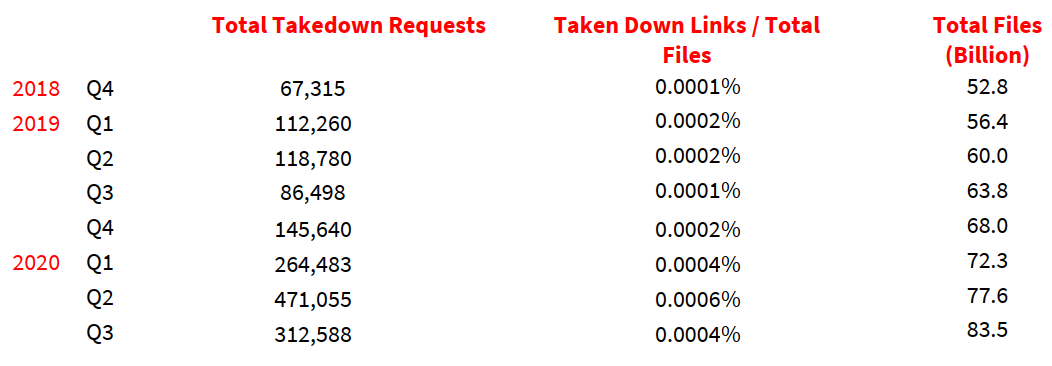
During the most recent reporting period spanning 12 months to September 2020, rightsholders filed 1.193 million takedown requests with Mega, which sounds like a lot but when compared to the overall storage maintained by the site, percentages are low.

During the months covered by the report, the total number of links and/or files taken down peaked at just 0.0006% of the site's total files, having hit a low of 0.0002% of total files during the first quarter. (Note: Mega's first reporting quarter is Q4 of the previous year)
Mega Transparency 2020

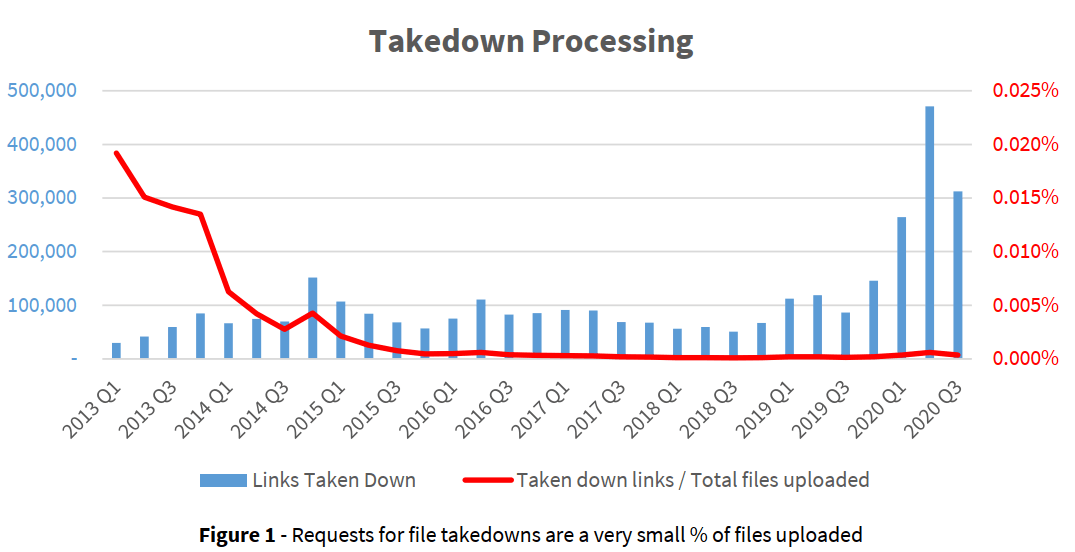
While Mega took down many more links/files during its last 12 month period than it did in any previous year since its inception, the report suggests that in terms of overall content, Mega has a very low ratio of infringing versus non-infringing content.

The chart below shows a general upward trend of links taken down in 2019/2020 but the almost flat red line since 2017 reveals that despite a worrying start back in 2013, the percentage of links/files that aren't considered infringing on the service are now keeping ratios well and truly pinned back.
Mega Takedowns 2020

"The number of unique takedown requests submitted represents a very small percentage of the total number of files stored on Mega. In Q3 2020, the links taken down represented 0.0004% of the 84 billion files uploaded to Mega servers," the company writes.

Also a factor is the volume of incorrect notices sent to the company by copyright holders. Mega doesn't provide a specific number but does note that when users file counternotices, the majority are accepted by the company.

"This is probably because many content owners and agents trawl the Internet using robots which generate incorrect notices on behalf of copyright owners, and due to the failure of owners and agents to review the specific link content," Mega notes.

Dealing With Repeat Infringers

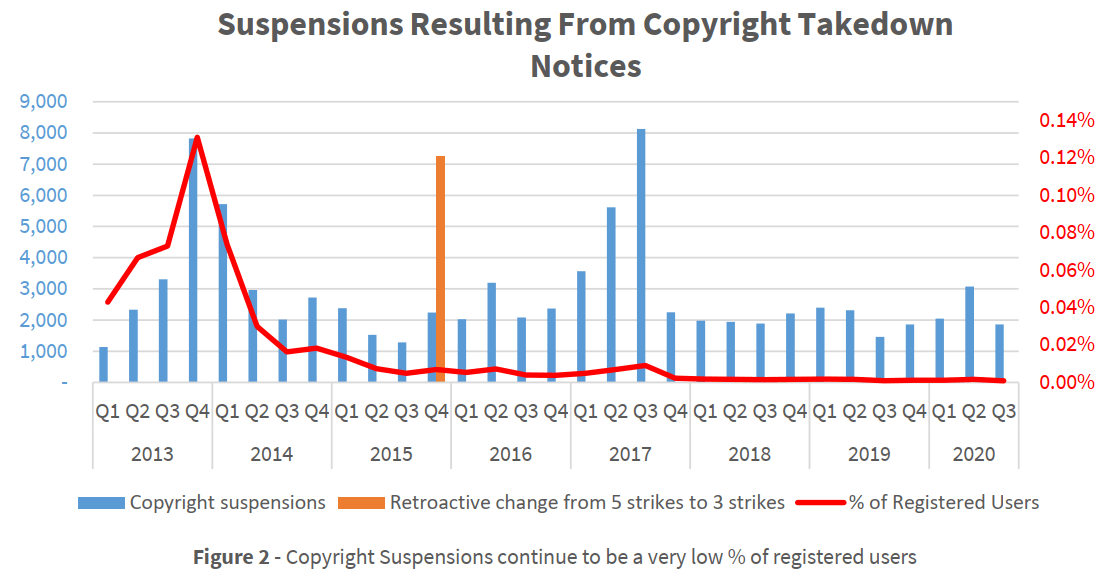
After initially operating a "five strikes" policy, in 2015 Mega introduced a "three strikes" regime to deal with users who receive multiple copyright takedown requests against their account. The company's policy applies to users who receive three valid complaints in any six-month period. While incorrect claims are disregarded upon successful appeal and don't count towards a ban, users reaching this limit have their accounts terminated.

"As of 30th September 2020, Mega had suspended 94,966 users for repeated infringement," the company notes, adding that the data reveals that "suspensions have declined to a very small % of the number of registered users."
Mega copyright suspensions

As the image above shows, Mega terminated around 8,850 users during the last 12-month reporting period, which is way down from the peaks observed in 2013, 2015 (change to 'three strikes') and 2017, and relatively stable when averaged out over the past three years.

Suspending Other Accounts Due to Objectionable Content

While terminating 95,000 users in total for repeat copyright infringement offenses may sound like a lot, that figure is dwarfed when it comes to the action taken by the company against those who upload child exploitation and other objectionable content. Mega says that it has terminated 565,000 accounts for storing and sharing this type of content and in all cases account information was made available to law enforcement agencies.

"Although all files stored on Mega are encrypted prior to being uploaded to our system, and we therefore cannot access that content unless we are provided with the decryption key, Mega does have access to user registration information and the IP addresses used to access our services," the company says in respect of handing user data over to the authorities.

"After 12 months, identifying information such as email and IP addresses is anonymized (except that email address records are retained for reference by the user's contacts or where the user has participated in chats with other Mega users), but other related database records may be retained. This includes records of financial transactions relating to a user's account where Mega is legally required to retain such information."

Mega's full transparency report can be found here (pdf)

From: TF, for the latest news on copyright battles, piracy and more.


Powered by Mad Mimi®A GoDaddy® company