Tuesday, November 28, 2023

TorrentFreak's Latest News


Google Bans 'Downloader' Again Following Markscan DMCA Notice
Andy Maxwell, 28 Nov 11:01 AM

downloader-logoCreated by software developer Elias Saba and released on the Amazon Appstore in November 2016, 'Downloader' offered two things; an empty URL field and a download button.

Downloader was intentionally basic but as a former Fire TV Product Manager at Amazon, Saba knew that a simple tool to transfer files would solve a fundamental shortcoming. Over 50 million installs of Downloader to date speak for the software's popularity but in May 2023, progress came to a screeching halt.

Several Israeli TV companies filed a DMCA complaint at Google Play alleging that Downloader offered copyrighted content. The companies supplied no details of the content allegedly infringed and said nothing about how 'Downloader' somehow managed to violate copyright law.

Google suspended Downloader leaving Saba no other option than to file a DMCA counternotice. The developer was forced to wait 10 business days for the complainants to respond and a total of 20 days for Downloader to be restored. After almost three weeks offline, Downloader had lost 47% of its active users.

Just six months later and it's happening all over again.

Another Baseless Copyright Complaint

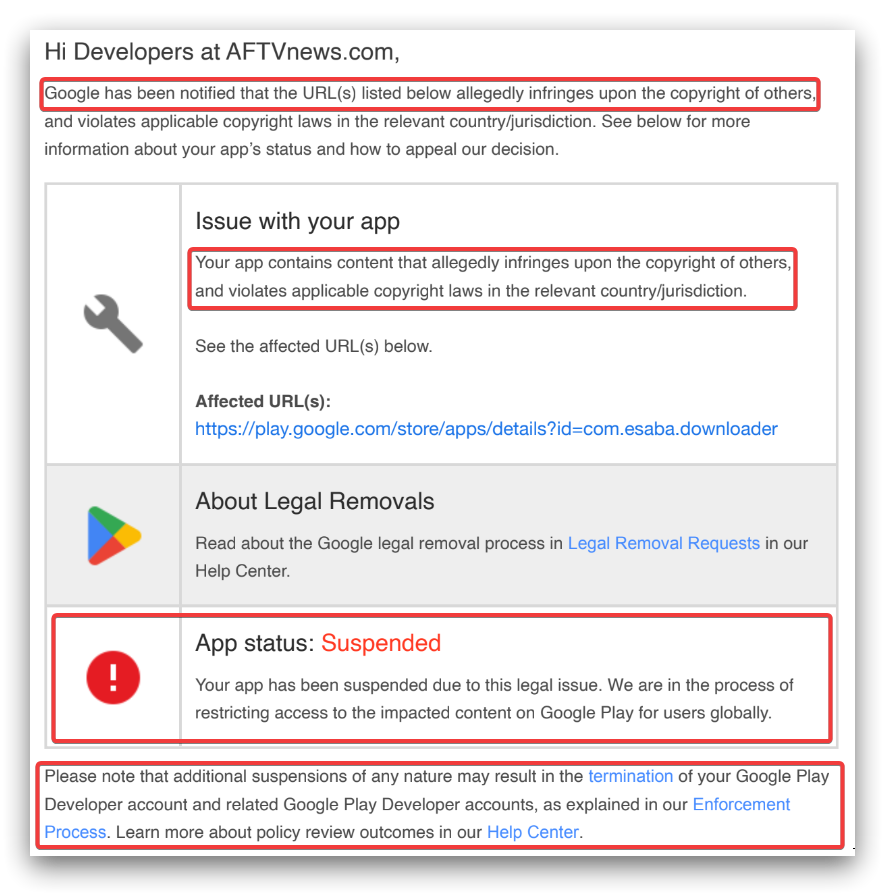
Speaking with TorrentFreak last evening, Saba calmly explained that a new DMCA takedown notice, filed by India-based anti-piracy outfit Markscan, had resulted in Google suspending Downloader once again. The news was delivered by Google on Sunday evening via the notice below.

Google Play DMCA Downloader

Deficient DMCA Notice, Entirely Deficient Claims

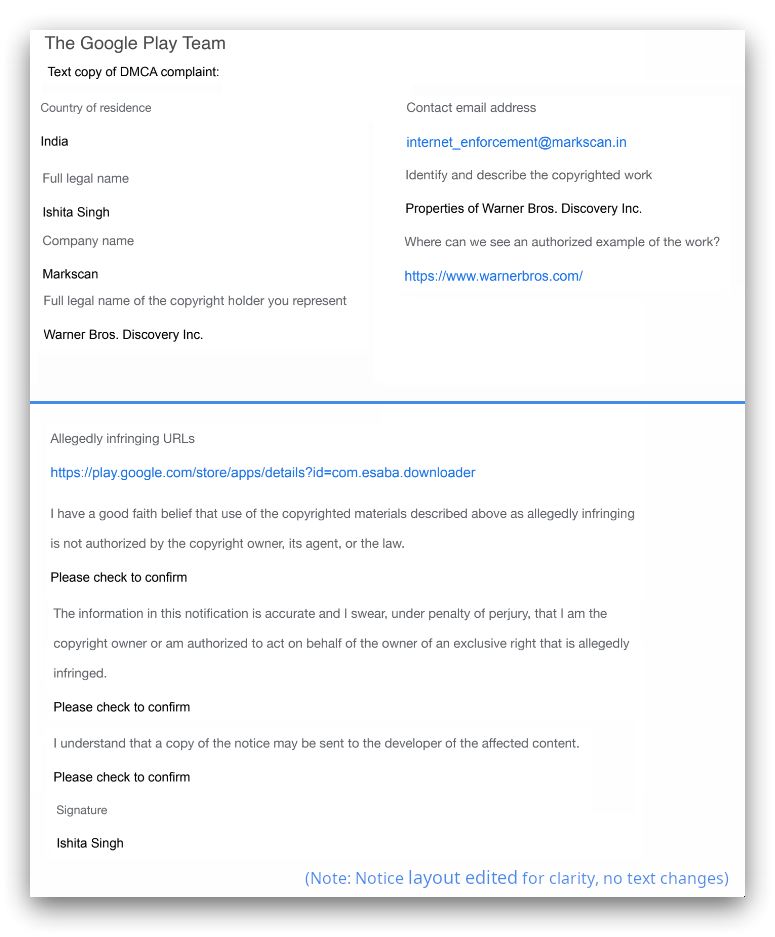
Given Downloader's limited capabilities, even a sensible discussion on the merits would've required Markscan to come up with something special. In the event, the DMCA notice filed at Google Play falls substantially short of the established minimum standard for removing a single URL, let alone an app boasting 50 million downloads.

Markscan-GooglePlay-DMCA-Downloader

In response to a request to 'Identify and describe the copyrighted work' allegedly infringed, the response 'Properties of Warner Bros. Discovery Inc.' is especially unhelpful.

In 2022, Warner revealed that its library consists of more than 145,000 hours of programming, including 12,500 feature films and 2,400 television series comprised of more than 150,000 individual episodes.

Alleging infringement of just one of these copyrighted works would've been trivial, had the DMCA notice stated a valid claim against an app that carries and indexes zero content, and is substantially less functional than a web browser.

Google says that it was notified that Downloader "allegedly infringes upon the copyright of others, and violates applicable copyright laws in the relevant country/jurisdiction." Logic suggests that any alleged infringement would indicate a violation of United States copyright law. However, if we take Markscan's home turf as an example, are vague allegations acceptable in India?

Just two examples picked at random (1,2, pdf) show that takedown notices filed by the same team offer a level of detail likely to meet standards almost anywhere. Why this wasn't replicated in the complaint against Downloader raises serious questions.

Another DMCA Counternotice, More Time Offline

On Monday evening, Saba filed an appeal at Google Play and 24 minutes later received notification that it had been rejected.

downloader appeal rejected

As a result the developer followed up with a DMCA counternotice. No response had been received at the time of writing.

Shortly after, Saba was contact by Google AdMob who informed him that ads in the Downloader app will stop being served if it isn't restored by Tuesday (today). The background to this message is interesting, as Saba explains.

"You see, I never had ads in my app and relied solely on donation buttons in the app. But when the app was suspended last time, I learned those donation buttons stop working, even for people that already had the app installed," he informs TorrentFreak.

"As a backup plan, in case the app was suspended again, I added ads to the app for the first time. Now I know it was a mistake going with Google for the ads since, evidently, they break those as well when the app is suspended. I just can't catch a break."

From: TF, for the latest news on copyright battles, piracy and more.

Court: Cloudflare is Liable for Pirate Site, But Not as a DNS Provider
Ernesto Van der Sar, 27 Nov 06:07 PM

cloudflare logoPopular Internet infrastructure service Cloudflare has come under a lot of pressure from copyright holders in recent years.

The company offers its services to millions of customers including multinationals, governments, but also some of the world's leading pirate sites.

Cloudflare Must Stop Pirate Site

Pirate sites have proven to be quite a headache for Cloudflare and have landed the San Francisco-based tech company in court on several occasions. This includes a case in Germany, where the local branch of Universal Music sued Cloudflare for offering its services to pirate site DDL-Music.

The lawsuit initially didn't make any headlines, but when Cloudflare displayed an 'Error 451' to DDL-Music users in early 2020, it was clear that something was up. The 451 error code is rare and typically reserved for cases where content has been made inaccessible for legal reasons.

In this case, Universal obtained a preliminary injunction against Cloudflare that required the company to stop providing its services to the pirate site. Failure to comply could've invoked a fine of up to 250,000 euros ($274,000) or, even worse, Cloudflare's managing director could've been sent to prison for up to six months.

Cloudflare complied with the order but took the case to appeal. The case eventually made its way to the Cologne Higher Regional Court, which handed down a mixed decision earlier this month.

Mixed Decision from Higher Court

In its decision, the Court confirmed that Cloudflare must take action against the blatantly-infringing pirate site, dismissing Cloudflare's concerns that this could lead to overblocking. According to the ruling, DDL-Music has no other purpose than to share pirated music and Cloudflare plays a central role in making the site available.

The ruling will come as a disappointment to the Internet infrastructure company, but there's a positive note as well. In addition to stopping its services to DDL-Music as a customer, Universal also wanted Cloudflare to block the site on its public DNS resolver 1.1.1.1.

The Cologne court concluded that a DNS blockade would be a step too far, as Cloudflare's DNS doesn't play a central role in making the site accessible. There are other DNS providers that do the same.

"[D]efendant's DNS resolver does not play a 'central role' in ensuring that the disputed music album could be freely shared on the Internet. The use of the defendant's DNS resolver was neither necessary to find the IP address via the domain name, nor does it make access easier," the court writes.

"The domain name could be resolved into the IP address just as easily using any other DNS resolver. The defendant's public DNS resolver 1.1.1.1 is just one of many freely accessible DNS resolvers, the best known and most used of which is the Google public DNS resolver 8.8.8.8. The defendant's DNS resolver therefore had no significant relevance to the accessibility of the infringing content of the disputed domain."

According to the verdict, a DNS provider operates in a purely passive, automatic and neutral manner. This sets it apart from hosting providers or CDN services, which can invoke liability under Germany's Telemedia Act (TMG) and EU law.

The DNS Blocking Frontier

The Cologne Higher Regional Court's ruling is significant, and not just for Cloudflare. After many countries established that pirate sites can be blocked by Internet providers, copyright holders are trying to expand similar obligations further up the intermediary chain.

In this case, the Court established that CDN services can be liable but drew the line at DNS resolvers. That could prove to be important for DNS resolver Quad9, which faces a similar legal battle in Germany.

The issue isn't limited to Germany either. A similar court order in Italy requires Cloudflare to block access to three pirate sites through its public DNS resolver.

These and other court orders will ultimately lead to important precedents going forward. However, the direct effect of the recent German ruling is rather limited. As Tarnkappe rightfully notes, DDL-Music has been offline since 2021, so there's no need to block it at all.

Heise reports that the German Federal Music Industry Association (BVMI) is nonetheless pleased with the outcome, as it shows that Cloudflare plays a "central role in making illegal content accessible."

According to the music group's Managing Director of Legal & Politics, René Houareau, the decision sends "a further signal against the illegal use of music recordings by tightening liability as real perpetrator liability".

From: TF, for the latest news on copyright battles, piracy and more.

270x90-blue

Are you looking for a VPN service? TorrentFreak sponsor NordVPN has some excellent offers.


Powered by Mad Mimi®A GoDaddy® company

Monday, November 27, 2023

TorrentFreak's Latest News


Several Piracy-Related Arrests Spark Fears of High-Level Crackdown
Andy Maxwell, 27 Nov 09:15 AM

denmark-target-sOver the past few years, increased enforcement by players in both the private and public sectors has made Denmark one of the riskiest places in Europe for pirate site operators and prolific file-sharers.

Relentless pushback from local anti-piracy group Rights Alliance and its partnership with Denmark's Special Crime Unit (National enhed for Særlig Kriminalitet (NSK)) has led to many site closures, arrests, and subsequent prosecutions.

The most recent reported conviction saw a 37-year-old man receive a 60-day suspended prison sentence in September for pirating more than a thousand works through local BitTorrent trackers.

In connection with this and other successes over the past few years, last month Rights Alliance revealed that Thomas Heldrup, the anti-piracy group's Head of Content Protection & Enforcement, had been running an undercover operation in piracy circles since 2016.

Fears of Infiltration

Concerns that a site might have a spy on board certainly aren't unusual; for many site operators, however, it's the kind of thing that only ever happens to someone else, usually those perceived to be less careful than them. In some cases that might be true but
Denmark's distinguishing features as a country may introduce complications.

A relatively small population and a language rarely spoken outside Denmark's borders, presents an increased chance of local piracy communities overlapping. Combine that with a shared reliance on locally attractive content and one site's security issues risk becoming a much broader problem, as the last couple of years appear to show.

Until recently, however, there were few signs to suggest those at the top of the so-called 'Piracy Pyramid' may also have become targets in Denmark. Nevertheless, some of those with connections to Scene entities are starting to ask questions.

47-Year-Old Arrested in Denmark

In a statement last week, Denmark's National Unit for Special Crime (NSK) announced that as part of a long-running investigation, a man was arrested on November 22 and then charged with copyright infringement offenses.

NSK said its officers searched the home of a 47-year-old man in South Zealand (Sydsjælland) and seized IT equipment in connection with illegal file-sharing and "copyright infringement of a particularly serious nature."

"The case is about an organized network that has illegally shared extremely large quantities of films and TV series via file sharing services," said NSK Police Commissioner Anders-Emil Nøhr Kelbæk.

While noting that NSK had no further information to offer at this time, Kelbæk said he was pleased that NSK had arrested another suspect believed to have played a 'significant role' in the unnamed network.

At Least Five Arrests Thus Far

Last week's arrest was only the latest in a series of arrests carried out as part of the same long-running NSK investigation into the illegal distribution of movies and TV shows.

In late August, NSK arrested four people on suspicion of sharing "extremely large quantities" of movies and TV shows. NSK raided addresses in South-West Jutland, North Zealand and Bornholmand. A 43-year old was arrested at the last location, but it's claimed he lives elsewhere. In common with last week's arrest, all were charged on suspicion of "particularly serious" copyright infringement offenses.

In an almost identical statement to that issued last week, Commissioner Anders-Emil Nøhr Kelbæk said the case was about "an organized network that shares extremely large amounts of data, presumably in the form of films and series."

Does Available Information Really Indicate a 'Scene' Bust?

TorrentFreak sources report concerns that last week's arrest may be linked to Scene groups. Terminology used by NSK doesn't instantly rule that out and does seem to suggest something potentially more significant than other arrests over the past few years.

According to NSK, the August arrests took place on August 28, 2023. Using information in Scene release databases we looked for Danish Scene groups and/or groups that were releasing Denmark-focused content before that date but then made no releases afterward; while that wouldn't provide conclusive proof that a group had been targeted, the method has proven useful in the past. Findings as follows:

⦿ Nordic blu-ray release group (including Danish) paused Aug 13, restarted Oct 16. Nothing since
⦿ TV show release group paused Aug 28 to Sep 1 but continued as normal
⦿ At least one TV show group made dozens of releases on Aug 28 suggesting little 'panic' on that date

While activity late August suggests nothing especially out of the ordinary, activity since the arrest last week stands in contrast.

Notable Danish content release group inactivity since November 22 arrest as follows:

⦿ 'HYGGE' | TV shows | 550+ releases since March 23 | Last release Nov 23, 2023 07:43:39
⦿ 'HiVE' | TV shows | 650+ releases since March 23 | Last release Nov 23, 2023 05:03:52
⦿ 'DKiDS' | TV shows | 3000+ release since March 23 | Last release Nov 21, 2023 10:34:50
⦿ 'DANES' | TV shows | 640+ releases since May 23 | Last release Nov 22, 2023 08:13:21
⦿ 'JYSK' | TV shows | 520+ releases since March 23 | Last release Nov 23, 2023 08:20:39

TF is informed that some groups may have gone dark simply out of an abundance of caution. That may or may not include all or none of the above. It's also possible that the groups have nothing to release. Furthermore, there are many other global groups with no obvious links to Danish content or Denmark that also stopped releasing on November 21. The reasons for this are unknown but holidays in the United States may play a role.

In an information vacuum, rumors are extremely common but if the authorities and/or Rights Alliance used intelligence obtained in other operations to infiltrate Scene groups or their affiliates, it wouldn't be a surprise. It wouldn't be surprise to hear that any group downtime was directly linked to turkey and/or alcohol consumption either but in any event, the next couple of weeks should prove informative.

From: TF, for the latest news on copyright battles, piracy and more.

Rightsholders Reported Five Million Unique 'Pirate' Domain Names to Google
Ernesto Van der Sar, 26 Nov 03:18 PM

dmca-google-s1Over the past few years, copyright holders have reported more than seven billion copyright-infringing URLs to Google.

At one point, the search engine processed close to three million links per day. A dazzling number to say the least.

In recent years the daily volume has slowly declined. This is in part due to Google's active policy of making pirate sites less visible in search results. After years of complaints, these efforts were well received by copyright holders.

Five Million 'Pirate' Domains

In response to Google's enforcement efforts and other anti-piracy measures, some pirate sites regularly switch to new domain names. That can help to get these sites back into the search results, albeit temporarily, since progress often doesn't last.

This week, the search engine reached a new milestone. Since its records began, Google has now received takedown notices for five million unique domain names.

5 million google

This 'achievement' prompted us to take a close look at the underlying data. Where are all these alleged pirate sites coming from? Who are the main offenders, and which domains shouldn't be on the list?

Top Offenders

The two top-reported domain names, daft.sex and dsex.to, are relatively new. These adult sites were targeted in a massive enforcement effort by Pornhub's parent company Mindgeek, which previously filed a lawsuit against the sites' operator in a U.S. federal court.

After the Daftsex site lost its .com domain, it moved to alternatives, which were then targeted by Mindgeek both in court and through Google. The daft.sex and dsex.to domains had only been active for a few months but triggered close to a quarter billion takedown notices in that short period.

top takedowns

The other domain names in the top ten are a mixed bag. In third place, we find file-sharing service 4shared.com with more than 68 million targeted URLs. The majority of these were removed years ago. More recently, 4shared began actively working with rightsholders to prevent piracy by deploying filtering technologies.

The list also includes unknown sites such as mp3toys.xyz. This domain has been inactive for more than half a decade but previously hosted pirated MP3s, triggering over 50 million reported URLs.

20 Domains Received 10% of All Notices

While looking through the list of targeted domains it becomes apparent that it's top-heavy. The 20 domains that were called out most frequently have nearly 750 million flagged URLs. This means that less than two dozen targeted domains account for more than 10% of all notices.

This means that while five million domains is an impressive number, it doesn't mean that all pose an equal threat. There's a long tail of sites that were targeted less than a handful of times.

Overall, we can say that the majority of the five million reported domains are only flagged incidentally. These may be smaller pirate sites or sites exploited by scammers to post spam links. However, it's also very common for legitimate sites to be targeted, often by mistake.

Legal Sites?

The five million figure includes a wide variety of domains that obviously don't deserve the 'pirate' brand. This includes dictionaries, which sometimes list terms that are associated with copyrighted content, for example. The same is true for many reputable news outlets such as The New York Times, the BBC, and TorrentFreak.

Ironically, Google also received takedown requests for pretty much all legitimate streaming platforms. Netflix was flagged 259 times over the years, while Disney+, HBO, Hulu, Paramount+, and many others were reported too. These are all errors, but they still contribute to the overall total.

Rightsholders have also reported Google.com URLs to Google, and not just a handful either. Over the years the company was asked to remove 775,454 Google.com URLs from its own search results.

Tens of Thousands of Copycats

Finally, it's worth pointing out that the reported domain names include a lot of variations of the same pirate brands. Some of these are operated by the original owners, but popular names are also hijacked to draw search traffic.

The list of five million domain names includes nearly 1,000 sites that have the phrase "piratebay" in their name and the same is true for "fmovies" and "YTS". The "123movie" brand takes the crown, however, with well over 3,000 domain name variations.

Overall, it is safe to say that the milestone of five million flagged domains should be seen in the proper context. On the one hand, it consists of a small group of notorious pirate sites. On the other, many more sites don't deserve the piracy label.

From: TF, for the latest news on copyright battles, piracy and more.

270x90-blue

Are you looking for a VPN service? TorrentFreak sponsor NordVPN has some excellent offers.


Powered by Mad Mimi®A GoDaddy® company