Saturday, October 3, 2020

TorrentFreak's Latest News


Megaupload Lawsuits Remain on Hold Until 2021, Or (Much) Later
Ernesto Van der Sar, 03 Oct 11:39 PM

love megaupload kardashianThere are a few recurring themes TorrentFreak has covered over the past decade, with the Megaupload case being a prime example.

For those who haven't been around long enough, Megaupload was once one of the largest file-sharing empires on the Internet. It was founded in 2005 and grew exponentially in the years that followed.

The site first made mainstream headlines late 2011, when it released the Megaupload song, a PR stunt of epic proportions that took the Internet by surprise.

Mega PR

While copyright holders had just framed the site as the largest piracy threat on the Internet, top artists and celebrities including Alicia Keys, Kanye West, Snoop Dogg, Kim Kardashian, Will.i.am and even boxer Floyd Mayweather endorsed the site.

The video was viewed millions of times in a matter of hours and became a smash hit. Universal Music swiftly pulled the video offline with a dubious copyright claim, which only increased its popularity, adding to the embarrassment.

What the Megaupload team didn't know, however, is that American and New Zealand law enforcement officials were already planning to take the site down for good.

Megaupload Takedown

Barely a month after the Megaupload song came out, helicopters and armed police forces were storming the New Zealand mansion of the site's founder Kim Dotcom. They acted on behalf of the US, which announced a criminal prosecution into the Megaupload conspiracy.

Today, nearly nine years have passed but Kim Dotcom and his former colleagues are still fighting a legal battle in New Zealand to prevent their extradition to the US, for which the final decision has yet to be issued.

While all parties await the outcome, the criminal case in the United States remains pending. The same goes for the civil cases launched by the MPA and RIAA in 2014, more than six years ago.

Lawsuits Remain on Hold

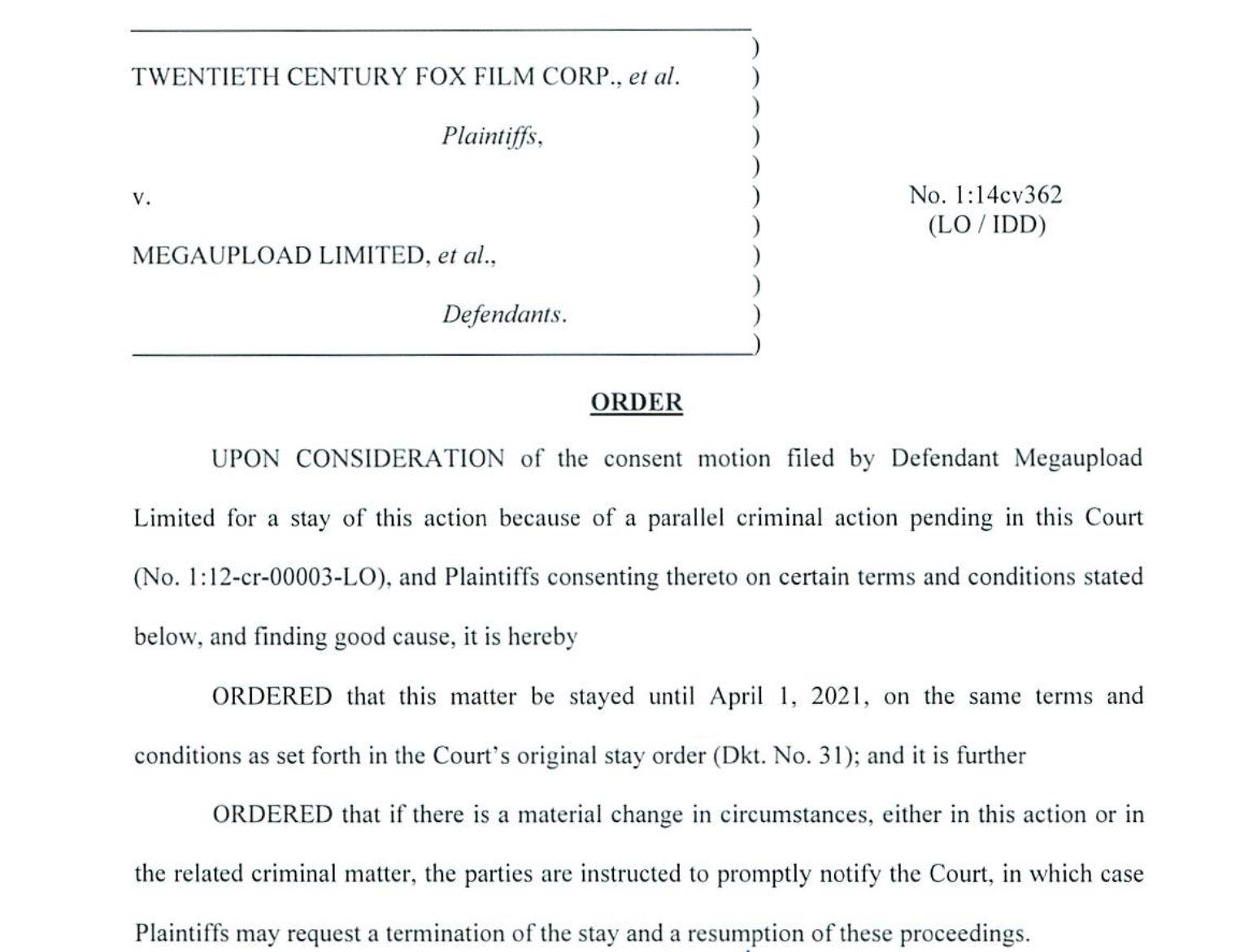
Since the civil cases can potentially influence the criminal proceedings, Megaupload's legal team previously asked to put these cases on hold, and last week they requested another extension, which was swiftly granted by the federal court in Virginia.

megaupload stay order

With no objections from the MPA and RIAA, it is no surprise that the stay until April 2021 was granted. If anything, these motions serve as a bi-annual reminder of the lack of progress in the Megaupload case.

How Much Longer?

The extradition process in New Zealand may very well continue for several more years. And in the event that the defendants are extradited, it can take much longer before the criminal case concludes. This means that 2021 may eventually become, 2022, 2025, 2030, etc.

A few years ago there were concerns that the long delays could result in the destruction of evidence, as some of Megaupload's hard drives were starting to fail. However, after the parties agreed on a solution to back-up and restore the files, this is no longer a problem.

There have also been attempts to make it possible for millions of former Megaupload users to retrieve their personal files. However, in recent years there hasn't been any update on this front, and it's unlikely that this will change anytime soon.

By now it's pretty clear that the original Megaupload site will never return. However, the Megaupload song lives on.

From: TF, for the latest news on copyright battles, piracy and more.

New Law Requires Google & Apple to Remove Pirate Apps or Face ISP Blocking
Andy Maxwell, 03 Oct 01:44 PM

Pirate AppleFor well over a decade copyright holders have been developing their capabilities to block sites at the ISP level. Specially crafted "no fault" injunctions obtained around the world mean that thousands of sites are now inaccessible (at least directly) by local audiences.

Of course, piracy hasn't stood still since the first blockade was put in place in Denmark around 2006. Site operators have come up with various techniques to nullify ISP blocking but over the past several years a new threat has emerged. Piracy-enabling apps that provide access to movies, TV shows, music and live sports are now favored by millions of users and they are not so easy to block.

These apps typically aggregate content from a range of underlying pirate mechanisms, which can move, shift and mutate at the will of their developers. Blocking this content is a grand game of whack-a-mole so, over in Russia, copyright holders and the government have come up with new legislation to restrict access to the apps themselves.

New Law Will Target Distributors of Piracy-Enabling Apps

After two years in the making, this summer the final text of new amendments to copyright law were adopted by the State Duma. After being signed by President Putin the law came into effect this week, October 1, 2020, with a goal to put pressure on app developers and the pirate app ecosystem itself, rather than tackle illegal content directly.

While apps of all kinds need developers, those developers need a platform from where to reach the public. Given today's mobile markets, that's likely to mean Google Play or Apple's App Store which together dominate the market.

Being listed on either is a great start to building a large audience for a pirate app so the new law wants to stop that in its tracks, before it becomes too much of a problem. All app distributors, therefore, will have to remove pirate apps quickly from their platforms or face the consequences.

One Way or Another, Pirate Apps Must Be Removed Quickly, Or Else

The system will be implemented as follows. Copyright holders will file complaints about pirate apps with telecoms regulator Roscomnadzor, which will determine, within 72 hours, who is hosting the software. This could be Apple or Google, another index of apps, or indeed any other web resource.

Once the location has been identified, Roscomnadzor will send a copyright infringement notice (in English and Russian) directly to the platform detailing the infringing content in the complaint and whose rights it breaches. Along with that will come a demand to restrict access to that content which in most cases is likely to mean a complete removal of the app itself.

The platform will then be required to identify the person who uploaded the software, typically its developer, that a notice of infringement has been filed. The developer or other responsible party will then have 24 hours to address the infringement within their software, such as the provision of copyright-infringing movies or TV shows. This could mean implementing restrictions so that the app doesn't continue to infringe or even the wholesale removal of the app from the distribution platform itself.

Responsibility Ultimately Falls On The App Distributor

If the developer takes no action to remedy the situation, the responsibility for preventing ongoing infringement will fall back to the app distribution platform, such as Apple, Google or any other site/system with similar functionality. They will then have to remove or block access to the software to avoid becoming a target themselves.

"In case of refusal or inaction of the owner of the software application, the owner of the information resource on which the software application is located, or another person who provides the placement in the information and telecommunication network, including the Internet, of the software application, are obliged to restrict access to the corresponding software application no later than the expiration of three working days from the date of receipt of the notification," the law reads.

Failure to Comply Will Mean ISP Blocking

In the event that neither the software developer nor the distributor takes remedial action to prevent the infringement listed in the complaint, Roscomnadzor will now be able to issue an instruction to have the distributor itself blocked by all Internet service providers in Russia.

Whether ISPs will be able to precisely prevent access to specific apps will remain to be seen but in the past there have been instances of over-blocking due to technical issues or limitations, leaving other aspects of platforms or indeed their entire operations blocked in Russia. The new law doesn't seem to require surgical blocking either.

"In case of refusal or inaction of the owner of the information resource, the hosting provider or another person specified [..] shall be obliged to restrict access to the relevant information resource immediately after the expiration of a day after receiving the [original] notification," it reads.

From: TF, for the latest news on copyright battles, piracy and more.


Powered by Mad Mimi®A GoDaddy® company

Friday, October 2, 2020

TorrentFreak's Latest News


US Indicts Members of 'Piracy' Group Team-Xecuter, Two Arrested
Ernesto Van der Sar, 02 Oct 11:50 PM

Team-Xecuter BannerTeam-Xecuter is widely known for creating 'hacks' that bypass digital restrictions on Nintendo consoles.

The group has been chased by Nintendo for years, but today, their operation has become the center of a criminal case prosecuted by the US Government.

The US Department of Justice just announced that two members of Team-Xecuter were arrested recently. Max Louarn, a 48-year-old French national, and the 51-year-old Gary Bowser from Canada are in custody and charged in a criminal conspiracy. The indictments also name a third defendant, a Chinese man named Yuanning Chen (35), who remains at large.

The three indicted members are just a minority of the total group. According to the US authorities, there are more than a dozen Team-Xecuter members scattered around the world. These members help to code and create the Nintendo hacks, but they are also suspected of being involved in the production and sale of these devices.

The indictment portrays Team-Xecuter as a criminal enterprise and notes that its members did their best to evade law enforcement by using a variety of brands, websites, and distribution channels.

"These defendants were allegedly leaders of a notorious international criminal group that reaped illegal profits for years by pirating video game technology of U.S. companies," said Assistant Attorney General Brian C. Rabbitt of the Justice Department's Criminal Division.

"These arrests show that the department will hold accountable hackers who seek to commandeer and exploit the intellectual property of American companies for financial gain, no matter where they may be located."

At the time of writing the official Team-Xecuter website remains online. Various online stores are also still selling the group's chips, including the latest SX Lite, and the SX Core for the Nintendo Switch.

Team-Xecuter has repeatedly stressed the legal uses of its hacks. Speaking with TorrentFreak, Team-Xecuter defended its work just a few weeks ago

"We are firm believers of the right to repair legislation, a growing movement to counteract the monopolistic control over hardware which is the property of the consumer who paid for it in the first place," Team-Xecuter said at the time.

According to the Department of Justice and the FBI, this was nothing more than a facade.

"The overwhelming demand and use for the enterprise's devices was to play pirated videogames. To support this illegal activity, Team Xecuter allegedly helped create and support online libraries of pirated videogames for its customers, and several of the enterprise's devices came preloaded with numerous pirated videogames."

The three defendants are charged with 11 felony counts including conspiracy to commit wire fraud, conspiracy to circumvent technological measures and to traffic in circumvention devices, and conspiracy to commit money laundering.

Defendant Bowser resided in the Dominican Republic when he was arrested in September and has since been deported to the US. Louarn is in custody in Canada pending a U.S. extradition request, so he can stand trial in the US.

This is a breaking story, we may amend this article and will report on the exact details of the charges in future reporting.

From: TF, for the latest news on copyright battles, piracy and more.

HorribleSubs Pirate Anime Site Throws in the Towel, "Killed By COVID"
Andy Maxwell, 02 Oct 11:43 AM

HorribleSubsMore than a decade ago, anime-focused site HorribleSubs launched with a mission to provide subtitles for anime. In a Reddit AMA eight years ago, the site's operator put a little more meat on the bones.

"We mainly do it to piss off CrunchyRoll, as stated in our mission statement. Philosophically, however, we started off disliking how CR fucked fansubbers up in the ass," the site's 'Great Leader' wrote.

It Began With Subtitles and Then Grew….and Grew

Over the years, HorribleSubs spread its wings way beyond its original mission, eventually distributing vast volumes of not only subtitles but also full copies of anime shows using BitTorrent. This supply of media made the site a favorite among fans and according to SimilarWeb stats, the platform enjoyed in excess of 11 million visits in August alone.

Clearly, both rules 2 and 5 of the site, dictating that no one should "talk about HorribleSubs" were widely ignored. Soon, however, it seems this banned topic of conversation will die out on its own. In a farewell message posted just a few hours ago, the site's operator reveals that HorribleSubs has shut down, with immediate effect.

"We have grown way beyond what was originally imagined. But… as the cliché saying goes, all good things must eventually come to an end," the announcement reads.

"This was a hard decision to make for the team, but the truth is, our real life responsibilities have been growing, especially in the times of COVID-19. COVID-19 has really impacted us in various ways, but ultimately it negatively affected how much time we were able to frequently contribute.

"After some reflection and evaluation, we realized moving on was the best way forward. You could technically say COVID killed HorribleSubs."

HorribleSubs Didn't Go Unnoticed By Copyright Holders

Given the scale of the platform and its userbase, it's no surprise that copyright holders used various tactics to take the site down or render it less accessible.

In January 2019, for example, HorribleSubs was targeted in an Australian blocking injunction filed by Village Roadshow, Disney, Twentieth Century Fox, Paramount, Columbia, Universal, Warner and local anime distributor Madman Entertainment. The order was handed down in June that year, with many local ISPs blocking HorribleSubs along with dozens of other sites.

Just over a year later in July 2020, Disney Enterprises took similar action in India, obtaining an injunction from the High Court in Delhi compelling local ISPs to block 118 'pirate' domains. Among them were several anime-focused platforms including Kisscartoon/Kimcartoon, Wcostream/watchcartoononline, kissanime, gogoanime, and 9anime. And, of course, HorribleSubs.

The Future Without HorribleSubs

While HorribleSubs itself is officially no more, anime fans will probably seek to fill the gap by using alternative platforms such as NYAA, which at last count was the fifth most-popular torrent site on the entire Internet.

While it's not a direct replacement, NYAA carries huge amounts of content released by HorribleSubs. Indeed, if stats produced by NYAA are correct, it currently has in excess of 68,260 HorribleSubs torrents in its index.

In its parting message, HorribleSubs adds that it will keep its Discord up and may even post additional information about the shut down sometime in the future. At the time of writing, thousands of people are in the channel discussing the unexpected news.

From: TF, for the latest news on copyright battles, piracy and more.


Powered by Mad Mimi®A GoDaddy® company

Thursday, October 1, 2020

TorrentFreak's Latest News


House Committee Hearing Shows Disagreement on How to Fine-Tune the DMCA
Ernesto Van der Sar, 01 Oct 09:48 PM

america flagAfter several years of public consultations and stakeholder meetings, the US Copyright Office published its review of the DMCA's safe harbor provisions this May.

The report doesn't propose any major overhauls of the DMCA. Instead, it aims to fine-tune some parts, to better balance the interests of copyright holders and online service providers (OSPs).

The more drastic suggestions were put on the backburner. Those include pirate site blocking and a 'takedown and staydown' requirement for online services, which would require mandatory upload filtering.

House Judiciary Committee Hears Stakeholders

The report is influential and serves as a basis for future legislation. However, no bills have been tabled yet. Instead, discussions remain ongoing and yesterday the House Judiciary Committee held a stakeholder hearing on the report that itself was the result of numerous stakeholder meetings.

The hearing allowed representatives from various sides to have their say on the Copyright Office report. This, once again, showed that artists and copyright holders are demanding stricter regulation. At the same time, technology companies and civil rights groups warn against the negative consequences of drastic measures.

The only overarching conclusion, if there is one, is that the current DMCA is not perfect. However, the parties clearly differ on what, if anything, should change.

Upload Filters and Automated Takedowns

Last year "upload filters" were a hot topic when the EU drafted its new Copyright Act and the topic is high on the US agenda as well. In its report, the Copyright Office cautioned that further research would be required for it to be seriously considered. According to many artists and rightsholders, however, it's a no-brainer.

Automated takedown tools and filters were also frequently mentioned in yesterday's hearing. According to Meredith Rose from Public Knowledge, a Washington-based public interest group, automated filters threaten free speech.

"Because they operate automatically, these algorithms have the remarkable power to almost instantaneously erase speech — including political speech, education, news, and speech which supports the livelihoods of millions of creators who derive their primary income via platforms with algorithmic content matching," she testified.

This notion was contested in the testimony of actress and singer Morgan Kibby, who represented the voice of smaller individual creators. A voice that was amplified and supported by the music industry group RIAA.

Stifling Free Speech or Artists?

"I've heard some claims that implementing a system that takes down infringing copies promotes censorship. However stripping creators of their fundamental rights, their livelihood, and ultimately their creative contributions is the real censorship," Kibby said.

The current system stifles creation according to Kibby, who suggests that online services are reluctant to change because they indirectly profit from the traffic generated by pirated content. In any case, it wouldn't be hard for tech companies to do more.

"Clearly, service providers can do more. My area of expertise is art; theirs is technology. They can create algorithms to help you discover new artists or predict what song you want to hear next; surely they can find ways to curtail the flow of infringing works on their platforms," she noted.

Repeat Infringers

These are just two fragments from the testimonies that were given, but they clearly set the tone. There is little disagreement. This also applies to the "repeat infringer" issue.

The DMCA currently requires ISPs and hosting services to implement a reasonable policy to deal with frequent offenders. However, the law doesn't clearly define what a repeat infringer is and when a termination is appropriate, which has led to a lot of uncertainty.

In its report, the Copyright Office recognized this problem and urged lawmakers to provide more clarity, without providing any concrete suggestions. The various testimonies yesterday offered several suggestions, but again, there's little agreement.

The Copyright Alliance, for example, said that it's easy for persons to resubscribe after being disconnected, and it urges the Government to ensure that repeat infringer policies become more effective.

"That is why OSPs and copyright owners, with the assistance of government, need to work together to ensure that repeat infringers policy are effective and being implemented as intended. Through such cooperation, OSPs should be able to adopt more acceptable repeat infringer policies."

At the same time, Jonathan Band from the Library Copyright Alliance spoke out against any changes to the standards for terminating the accounts of repeat infringers. Instead, he urged lawmakers to look more closely at the abuse of takedown notices.

"The Copyright Office report itself did not give sufficient weight to the problem of the abuse of the notice-and-takedown system. Despite evidence that as many as 30 percent of notices are defective in some manner, the Office did not recommend any concrete action by Congress to protect fair use and free speech."

The DMCA is Great/Broken

Overall, however, the Library Copyright Alliance is pretty satisfied with the current DMCA and it warns against drastic changes that may upset the current system.

"We live in a golden age of content creation and distribution. The DMCA is in large measure responsible for this golden age. It is a shining example of enlightened legislation for the public good. We disturb it at our peril."

This stance runs completely counter to that of some artists and rightsholders, who believe that the DMCA is broken and argue that change is absolutely necessary.

"It's worse than just broken," Kibby notes in her testimony. "It is undermining creativity, and more alarmingly, quietly undercutting our next generation of artists. It is jeopardizing livelihoods for working-class musicians, obliterating healthy monetary velocity in our creative community."

There's More than the DMCA

Finally, Matt Schruers from the CCIA, which represents major tech companies including Amazon, Google and Facebook, stressed that promoting legal access can do more than any DMCA changes can.

"In the sense that 'the best defense is a good offense,' the most effective way to prevent the infringement of copyrights is to ensure that members of the public, most of whom want to pay for content, can lawfully consume works digitally whenever and wherever they want," Schruers said.

In many ways, yesterday's hearing was a repeat of the same arguments we have heard in many hearings, meetings and panels over the years. If it made anything clear it's that it will be impossible to come up with a solution that pleases everyone involved. But perhaps that's something to discuss in the next meeting.

A video of yesterday's hearing and all the testimonies cited here can be found at the Judiciary Committee website

From: TF, for the latest news on copyright battles, piracy and more.

UEFA Obtains New Pirate IPTV Blocking Injunction Against Irish ISPs
Andy Maxwell, 01 Oct 09:51 AM

Red CardOver the past several years, the Premier League has obtained blocking orders from the High Court of England and Wales, which compel ISPs in the UK to block pirate streaming services.

These so-called 'dynamic injunctions' are more flexible than their torrent and streaming site counterparts due to their ability to react more quickly, blocking streams as they appear close to and during match times. The idea is to frustrate customers of pirate IPTV services in particular, so that they migrate back to official offerings.

UEFA Begins to Block Pirate IPTV Streams in the UK

Back in 2017, UEFA, the governing body of football in Europe, decided that it too could benefit from this type of legal action. Following in the steps of the Premier League, UEFA obtained a similar High Court injunction that compelled ISPs including BT, Virgin, Sky and TalkTalk to block pirated match streams in the UK. The effort was expanded a year later.

Soon after, the Premier League expanded its blocking efforts to Ireland, obtaining a stream-blocking injunction against several major ISPs including Eircom, Sky, Virgin and Vodafone. This summer the league obtained permission to continue its efforts in Ireland, a path now being followed by UEFA.

UEFA Obtains High Court Order to Begin Blocking in Ireland

After a successful application to the High Court, UEFA has now been granted permission to compel several local ISPs to block access to pirated match streams during the 2020-21 season.

RTE reports that in common with the injunction obtained previously by the Premier League, Eir (Eircom), Sky Ireland Ltd, Sky Subscribers Services Ltd, Virgin Media Ireland Ltd and Vodafone Ireland Ltd are covered by the injunction. This means that they will be required to work with UEFA's anti-piracy partners to render various IP addresses related to pirate servers inaccessible to their customers, at least during match times.

While the ISPs are now required by law to cooperate in UEFA's blocking efforts, only Sky came out in support of UEFA's application. While this should come as no surprise given its position as a broadcaster, companies including Virgin Media have a vested interest in stopping piracy of live games too.

As a result, the remainder of the ISPs did their part by remaining neutral, effectively guaranteeing that the injunction would be handed down, like those before it had too.

Of course, relevant issues were considered by the Court, including that such an injunction is not only necessary but not overly complicated either. Furthermore, costs of implementation must not be excessive while the interests of all affected parties – including those of Internet users – must also be respected.

However, having been down this path several times before, applicants and the courts are now very familiar with the procedure and the various parameters required to have injunctions signed off.

Blocking Injunctions Are a Well-Trodden Path

Despite their relative youth, dynamic blocking injunctions have developed quickly over the past three years but how they work from a technical perspective is a closely-guarded secret. The theory is simple; anti-piracy companies identify the broadcasting servers of pirate IPTV providers and feed these to ISPs so they can be firewalled but the precise parameters remain a closely guarded secret, albeit with some leaks.

These blocking efforts can usually be circumvented when IPTV subscribers deploy a VPN to nullify their ISPs' blocking measures, something which is now common practice among a growing subset of IPTV subscribers. However, this year there is talk of a new state of play on the ground in respect of the Premier League's ability to disrupt suppliers.

Precisely what is happening isn't yet clear to us but there are reports that some IPTV providers are finding the Premier League's efforts more intrusive than they were previously. The Premier League has already admitted that is has new powers for the coming season so time will tell who will come out on top, once the dust settles.

From: TF, for the latest news on copyright battles, piracy and more.


Powered by Mad Mimi®A GoDaddy® company