Thursday, September 3, 2020

TorrentFreak's Latest News


Cloudflare Shared Personal Details of Hundreds of Customers in Response to DMCA Subpoenas
Ernesto Van der Sar, 03 Sep 09:47 PM

cloudflarePopular CDN and DDoS protection service Cloudflare has come under a lot of pressure from copyright holders in recent years.

The company offers its services to millions of sites. This includes multinationals, governments, but also some of the world's leading pirate sites.

Many rightsholders are not happy with the latter. They repeatedly accuse Cloudflare of facilitating copyright infringement by continuing to provide access to these platforms. At the same time, they call out the CDN service for masking the true hosting locations of these 'bad actors'.

Cloudflare sees things differently. The company positions itself as a neutral service provider that doesn't 'host' any infringing content. They just pass on information that is cached on its services temporarily.

This means that if copyright holders report Pirate Bay URLs to Cloudflare, the company takes no action other than forwarding the DMCA takedown notices to its customer. By doing so, Cloudflare is convinced that it operates in accordance with the law.

Identifying 'Infringing' Customers

Not all rightsholders agree with this approach and some have filed lawsuits to hold Cloudflare liable. Others have gone to court to obtain DMCA subpoenas, which require the CDN provider to hand over all personal details it has on allegedly infringing customers.

We regularly report on these requests, which target torrent sites, streaming sites, and many other pirate portals. In its latest transparency report, Cloudflare reveals how many times it was asked to comply and what information was shared in response.

Over the past 12 months, Cloudflare received 58 DMCA subpoenas and the company answered all but one. Together, these affected more than 1,000 domains and close to 500 Cloudflare customers.

cloudflare transparency subpoenas

Previously it wasn't clear what type of records the company could hand over, but the transparency report provides more information on that as well.

What Information is Shared?

To comply with the subpoenas, Cloudflare can share the IP-addresses that were used to login to the site as well as the login times. In addition, it can hand over so-called 'basic subscriber info.'

"This basic subscriber data would include the information our customers provide at the time they sign up for our service, like name; email address; physical address; phone number; the means or source of payment of service," Cloudflare writes.

Whether copyright holders can do anything with this information remains a question. Many larger pirate sites are quite skilled at hiding the tracks that lead to their true operators. For smaller sites that may be different.

Website Blocking

The transparency report also touches on website blocking, which is another high-profile topic. While Cloudflare is very cautious with blocking, it may in some cases comply with law enforcement requests and foreign court orders.

"If we determine that the order is valid and requires Cloudflare action, we may limit blocking of access to the content to those areas where it violates local law, a practice known as 'geo-blocking'. We will attempt to clarify and narrow overbroad requests when possible," Cloudflare writes.

Cloudflare says it's cautious because of "the significant potential impact on freedom of expression." How many domains are blocked is not mentioned, but it does occasionally take action.

For example, earlier this year the pirate site DDL-Music.to was blocked in Germany following a court order.

Finally, we have to note that Cloudflare also offers hosting services to some clients. If that's the case, it will remove content when appropriate. That happened three times over the past year, affecting one or two domain names.

Cloudflare's latest transparency report is available here.

From: TF, for the latest news on copyright battles, piracy and more.

High Court Grants Premier League IPTV Blocking Order, Fans Beg For More Legal Options
Andy Maxwell, 03 Sep 11:33 AM

footballWhile there's no doubt that humans have been kicking objects around for fun for thousands of years, organized football as we know it today has existed in the UK since the 19th century.

Today, however, football faces a threat like never before. The coronavirus pandemic has thrown the sport into chaos, with schedules massively disrupted and leagues thrown into turmoil.

In an effort to return to some kind of normality the new Premier League season is set to start on September 12. However, with social-distancing restrictions still in place, fans will be banned from stadiums for the foreseeable future.

In the 21st century, the logical solution would be to air all Premier League matches on TV or via the Internet for UK fans to enjoy. At it stands, however, 160 of the planned 380 top-tier games will not be shown in the UK, leaving fans frustrated that they're being left behind. And there are good reasons for that upset.

If fans want to watch the limited matches that are available, they'll have to subscribe to several services – Sky Sports, BT Sport and Amazon Prime – at a cost of around £100 per month. If they want the rest, there's no legal option so combined with the price and lack of choice, some fans turn to pirate IPTV providers instead. That's something the Premier League is working to prevent.

Premier League Obtains a New Blocking Order

Over the past several years, the Premier League has obtained blocking orders from the High Court, which give it permission to compel ISPs to block pirate streaming services. The last order, which aimed to cover the 2019/2020 season, ran out on July 27, 2020.

However, ISP Virgin Media's portal now reports that new permission has been granted by the High Court via a "sealed order", which will cover the 2020/2021 season.

Virgin will be required to block "Various Target Servers notified to Virgin Media by FAPL or its appointed agent for the duration of the FAPL 2020/2021 competition season." While yet to publicly report the new order, all other major ISPs will be required to follow suit.

We've previously covered how these blocking orders work from a technical perspective. Their sole aim is to prevent people from watching matches via illegal providers but the plans for limited legal airings in the UK under pandemic conditions places these efforts into a whole new light.

UK Fans Are Being Backed Into a Corner

With significantly higher prices, a limited legal offering, and a stadium ban in full effect, UK fans are not only being backed into a corner, on the world stage they're being treated as second-class supporters of their own sport.

All Premier League matches are available to watch live in other countries and at vastly cheaper prices. Citizens of the US, for example, will be able to use NBC channels and streaming services to watch all 380 matches at a vastly reduced price.

Other international services showing matches unavailable in the UK include DAZN, Optus Sport, QQ Sports, Sport TV1, and fuboTV, but it is impractical and/or impossible for UK fans to access them all. Legally that is.

Pirate IPTV Providers Are The Ultimate One-Stop-Shop

By their very description, it's clear that pirate IPTV providers are illegal. That aside, what they do very effectively is cut through all the red tape. Football fans are not only greeted with the live matches offered by Sky and BT Sport, but also all of the matches offered by NBC and, where necessary, any and/or all of those shown by the other legal providers mentioned above.

While price is clearly a huge factor for UK fans, freedom to choose which matches to watch live is a massive draw too. The Premier League knows this, the government knows this, as does the Football Supporters' Association, which is campaigning for all games to be shown live in the UK.

"We all want to get back to games when it's safe to do so," said FSA Chief executive Kevin Miles in comments to the BBC this week.

"But it's not in anyone's interests to have a situation where fans excluded from grounds for reasons of health or Covid-related capacity reductions feel they have no option but to resort to illegal pirate broadcast schemes."

Comments from an IPTV Insider

Last evening TorrentFreak spoke with someone with inside knowledge of IPTV providers and he agreed that the new season will be covered in depth by pirate suppliers.

"All the games will be available through different providers like the ones you mentioned and many more, and will almost definitely increase the amount of people using illicit options. It's almost like [the Premier League] are trying to make more people use illicit options," he said, demanding anonymity.

"Illegal IPTV providers will use the legitimate sites to take the streams and redistribute them either via the original source URL or they will simply use HDMI encoders to do so. This is nothing new and in effect the illegitimate providers will continue most likely un-affected in obtaining the content.

"We cannot forget however that many people who watch the Premier League illicitly actually have a legit subscription and only use these services to watch the content that they are not able to watch legitimately," he added.

What Next and Will the Premier League Change Its Position?

At the moment, the Premier League has declined to comment but it does have a shareholders' meeting today so it's at least possible that something positive may come from that. Our IPTV insider is less optimistic, since he believes that any decisions made will be in the interests of the Premier League, not in the interests of fans. A glaring and persistent error, he says.

Whatever the outcome, at some point in the future the Premier League and indeed all providers of live sporting content will have to realize that if they are underserving supporters, someone else will come along and exploit that service gap. Blocking and pirate supplier crackdowns have a limited effect so it seems logical that in order to defeat them holistically, the consumer has to be played onside.

And that, as always, means putting all content into a convenient package and making that available to fans at a reasonable price. Until then, pirate suppliers have all the oxygen they need to keep taking a piece of the pie, not to mention a not insignificant slice of the revenue.

From: TF, for the latest news on copyright battles, piracy and more.


Powered by Mad Mimi®A GoDaddy® company

Wednesday, September 2, 2020

TorrentFreak's Latest News


Anti-Piracy Lawyer Files Application to Register RARBG Trademark
Ernesto Van der Sar, 02 Sep 09:44 PM

Copyright holders can take a wide variety of measures to address piracy, with some being more effective than others.

Hawaii-based attorney Kerry Culpepper has tried several different approaches. Given his profession, most of these take place in the legal realm.

That includes lawsuits against downloaders and owners of well-known pirate sites and apps, including YTS, MKVcage, Cotomovies, Popcorn Time, and Showbox. These actions have resulted in some successes, with sites and apps shutting down or paying thousands of dollars in settlements.

Aside from pursuing site operators with 'classic' copyright infringement claims, Culpepper also uses trademarks. Earlier this year he obtained the marks for popular pirate brands such as YTS, Popcorn Time, and Showbox. These were used to take social media accounts offline and in legal action against site operators.

RARBG Trademark Application

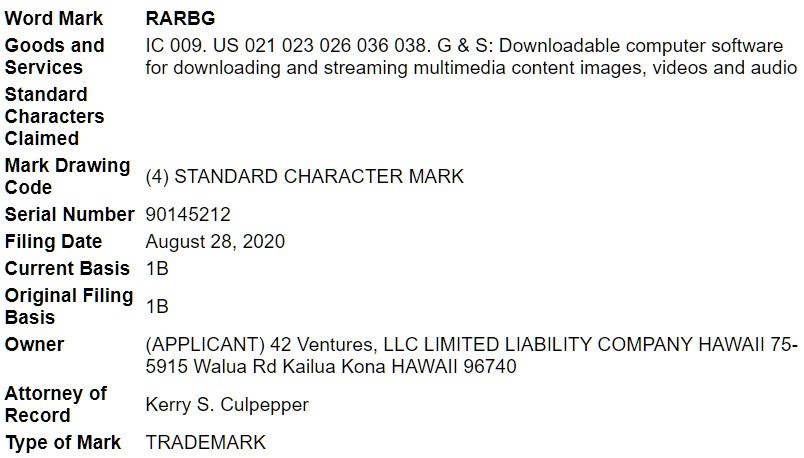
Last week, this quest continued with a new chapter. Through the Hawaiian company 42 Ventures, which lists Culpepper as the director, the anti-piracy lawyer filed an application for the RARBG trademark.

RARBG has been a household name in piracy circles and, as one of the most-visited torrent sites, it's certainly a high profile player. At the moment, 42 Ventures doesn't actively use the term RARBG anywhere but the trademark application is filed with the "intent to use."

Specifically, the application lists the intended use as "downloadable computer software for downloading and streaming multimedia content images, videos and audio."

rarbg trademark

One could argue that this application conflicts with the 'official' RARBG site that has been active for over a decade already. This is something the attorney is well aware of. In fact, it's brought up in an accompanying declaration.

"There are websites that have been operating under the name RARBG since at least 2008 that promote and distribute torrent files for illegally reproducing and distributing copyright protected content," Culpepper writes.

No Trademarks For Pirates

The existing RARBG sites are known for their "blatant piracy," Culpepper writes, adding that the US Trade Representative listed it as a 'notorious market.' Because the official site is believed to be unlawful, it should not be able to claim the trademark.

"I believe that any use of RARBG prior to the present application is not lawful use in commerce because the use of RARBG by the piracy websites is unlawful under federal law," the attorney explains.

The application process can take up several months and allows interested parties to object. This means that RARBG won't be affected immediately. However, that may change if the trademark is granted.

How the company plans to use or enforce the trademark is unknown. TorrentFreak reached out to Culpepper to request further details but the attorney declined to comment.

From: TF, for the latest news on copyright battles, piracy and more.

Another Trump Tweet Removed But This One Has a $150,000 Copyright Lawsuit Attached
Andy Maxwell, 02 Sep 12:16 PM

Donald TrumpFor the overwhelming majority of Twitter users, receiving even a very small number of copyright complaints against their account can mean its loss, with Twitter invoking its repeat infringer policy to avoid liability under the DMCA.

For US President Donald Trump, however, special treatment is available on the platform. While contentious tweets do get removed, Trump's account remains intact, despite a steady stream of rightsholders filing DMCA notices.

Yesterday, however, one of his allegedly-infringing tweets resulted in more robust action.

Allegedly-Infringing Tweet Was Posted in August

With the 2020 United States presidential election campaign in full swing, Trump is taking every opportunity to paint Democratic opponent Joe Biden in an unfavorable light. These political attacks often take place via Twitter and last month Trump kept up the pressure, posting an animated video of a speedy train carrying his campaign logo ahead of Joe Biden on a railroad handcar, struggling to keep up.

While that kind of imagery is nothing new in US politics and seems to have been custom-created, the background music in the video – the 1982 hit 'Electric Avenue' by British singer-songwriter Eddy Grant – was a previously-existing work. In fact, according to a lawsuit filed by the artist in a New York court yesterday, the use of the track was an act of blatant copyright infringement.

Copyright Infringement Lawsuit Filed in New York

The complaint, filed in the Southern District of New York, has Edmond Grant, two companies named Greenheart Music Limited (one based in the UK, the other Antigua, both owned by Grant) suing both Donald Trump and his campaign, Donald J. Trump For President Inc.

The complaint states that after Trump tweeted the video on August 12, the next day Grant and Greenheart Music sent a letter to the defendants demanding the removal of the video and insisting that they refrain from using Electric Avenue moving forward.

The lawsuit further alleges that at the time of its filing on September 1, the video was still available on Twitter. This is curious since according to information published by the Lumen Database, on August 13 Twitter received a DMCA takedown notice from Sony/ATV Music Publishing demanding the removal of the tweet.

It has now been actioned with the offending tweet being removed, but Lumen only received a copy from Twitter today, perhaps suggesting something unusual with its processing.

Electric Avenue DMCA

"Plaintiffs' Recording, which embodies the Composition, can be heard on the Infringing Video starting at the 15 second mark and continues for the duration of the video. The Infringing Video therefore makes unauthorized use of the Composition and the Recording and infringes upon Plaintiffs' copyrights in both," the complaint reads.

"Defendants' conduct is unlawful; it is proscribed as such by the United States Copyright Act. Neither the President nor the Company is above the law," it adds.

A Very Popular Video, Complaint Alleges

According to estimates presented by the plaintiffs, the video has been viewed more than 13.7 million times, "liked" more than 350,000 times, and re-tweeted 139,000 times. This, despite Trump and his campaign being put on notice via an August 13 letter sent by Grant's attorney to cease-and-desist their infringing conduct.

Eddy Grant - Trump

"Defendants have failed and/or refused to comply with Plaintiffs' demands set forth in the August 13, 2020 letter, have continued to infringe Plaintiffs' copyrights in the Composition and the Recording, and, upon information and belief, will continue to infringe Plaintiffs' copyrights in the Composition and the Recording unless enjoined by this Court," the complaint adds.

Permanent Injunction and Damages

Describing the actions of Trump and his campaign as "willful and intentional", the lawsuit demands a permanent injunction to prevent further infringement plus a damages amount to be determined at trial.

That could range from a minimum of $750 per infringement but could stretch to $150,000 per infringement in statutory damages, plus costs and attorneys' fees, the complaint warns.

Interestingly, the cease-and-desist sent by Grant's legal team on August 13 offered to settle the matter quickly, in order to avoid the relatively expensive option of a lawsuit. Whether that option remains on the table is unclear but from its text, it appears that Grant was personally upset, not just by the alleged infringement of Electric Avenue, but also by the context in which it was used.

Perhaps More Than 'Just Another' Copyright Lawsuit

Electric Avenue was written by Grant in response to the now-historic riots that took place in Brixton, London, during 1981. They were widely attributed to racism, poverty, and tensions between black youths and the mainly white police force of the time.

The cease-and-desist sent by Grant's team in August suggests that the use of Electric Avenue in the Trump campaign video "indicates a fundamental misunderstanding of the very meaning of the underlying work" and notes that just by being affiliated with Trump's campaign, Grant's reputation is being damaged. As a result, a large response could follow.

"If you know my client's reputation then you know that this Infringing Use in connection with the name 'Trump' in a political context is a serious transgression and could subject you to upwards of $100,000,000 in monetary damages," the letter warned.

The full complaint and August cease-and-desist letter are available here and here (pdf)

From: TF, for the latest news on copyright battles, piracy and more.


Powered by Mad Mimi®A GoDaddy® company

Tuesday, September 1, 2020

TorrentFreak's Latest News


New "Scene" Security Notice: 'SPARKS' Piracy Raids Busted Dozens of Sites
Andy Maxwell, 01 Sep 05:00 PM

Fire PirateLast Tuesday, exactly one week ago, unofficial reports began to surface that enforcement action was underway targeting groups and members of 'The Scene', the tight-knit entities that are often described as sitting at the top of the so-called 'Piracy Pyramid'.

As the hours began to pass, it was clear the initial reports were true. The unsealing of indictments in the United States, some dating back to January, later revealed that the US Government had homed in on at least three key members of the connected movie and TV show release groups SPARKS, GECKOS, DRONES, ROVERS and SPLiNTERS.

On Tuesday, Wednesday and subsequent days, chaos in The Scene was widespread. The USDOJ revealed that an operation was underway on three continents, with law enforcement partners in 18 countries carrying out raids and seizures, declaring that around 60 servers had been taken down.

Unofficial reports indicated that the activity was centered on Europe, particularly in Nordic countries, with Eurojust and Europol deeply involved in the operation.

New 'Scene Notice' – As Close as it Gets to a 'Scene' News Release

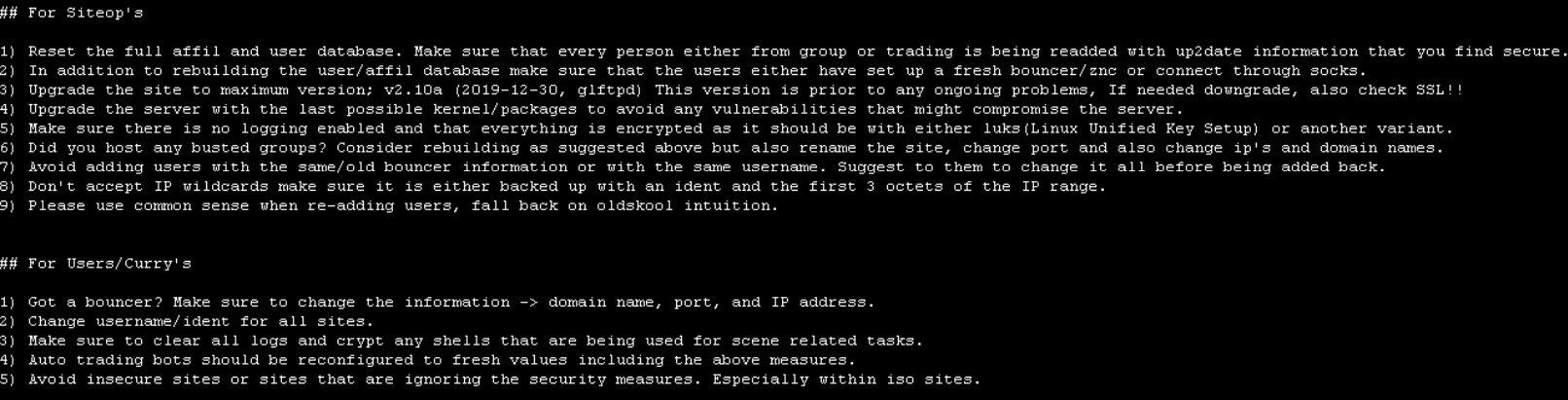
Since then, communication from inside The Scene itself has been sporadic at best but this morning the existence of a so-called 'Scene Notice' was revealed on public sites known as 'pre-databases'. This notice, basically a text file in .NFO format, reveals some interesting information from an insider's perspective.

So-called 'Scene Notices' are relatively rare, certainly when compared to the number of content releases put out by The Scene itself. When they do appear, however, they often carry security-related information, decrying one group or other for being insecure or perhaps accusing certain entities of behavior that could undermine operations.

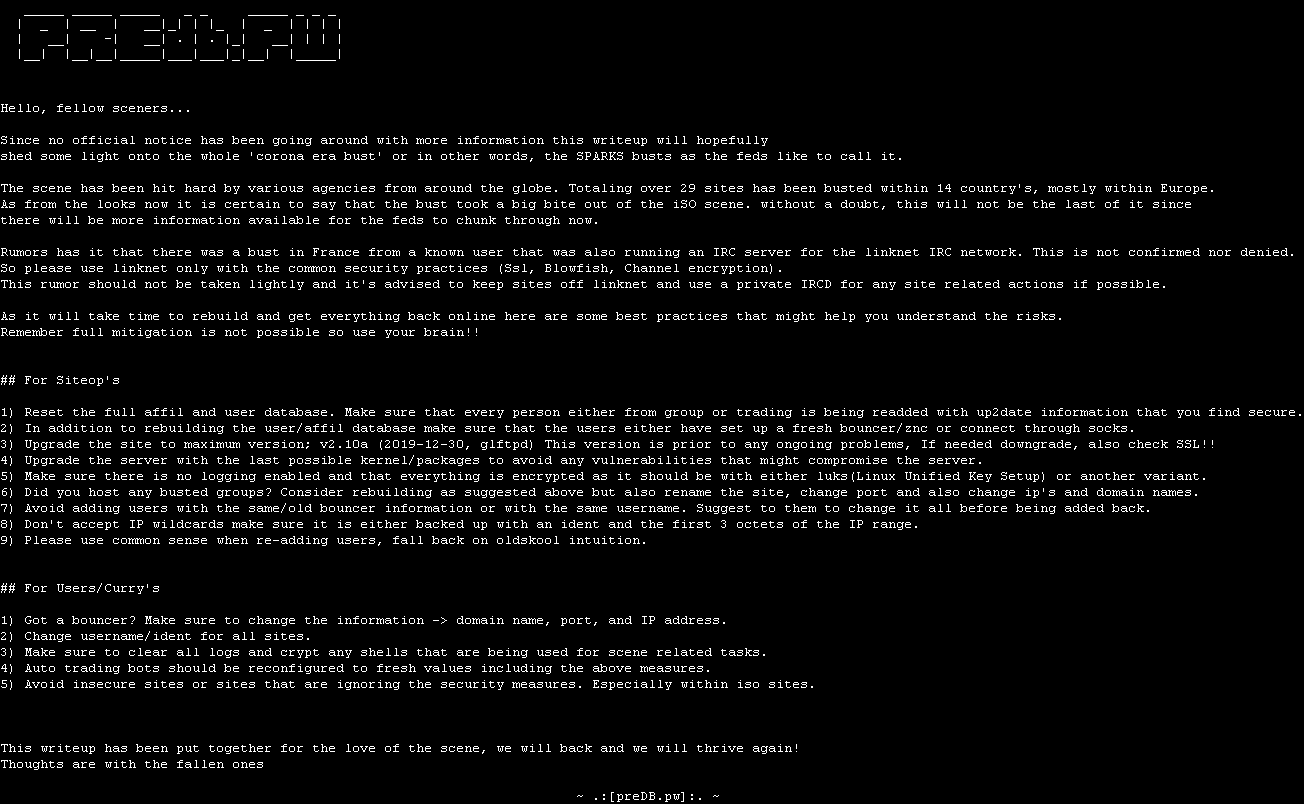
Sometimes it's possible to identify who writes these bulletins (groups or individuals) but in today's case, the author is unknown. Titled "Scene_busts_And_Mitigations", we reproduce quotes from it here, with some tidying but with grammatical errors intact.

It begins by noting that the purpose of the notice is to shed light on what it describes as the "whole corona era bust", aka the action against SPARKS and its affiliates. According to the notice, the action was indeed significant and could even be ongoing.

"The scene has been hit hard by various agencies from around the globe. Totaling over 29 sites has been busted within 14 country's, mostly within Europe. As from the looks now it is certain to say that the bust took a big bite out of the ISO scene. Without a doubt, this will not be the last of it since there will be more information available for the feds to chunk through now," it reads.

Indeed, from initial reports on Tuesday, through Wednesday and the rest of last week, we received various reports of continuing actions, most of which were hard or impractical to confirm. It seems logical to conclude, however, that as the authorities scooped up additional individuals suspected of crimes, plus their hardware and perhaps even their cooperation, more and more opportunities for further operations raised their heads. Some sources suggest that the number of sites taken down could already be closer to 50 than 30, but official details are hard to come by.

Possible Compromise of Internet Relay Chat (IRC)

While many in the lower (sometimes even just slightly lower) echelons of the piracy world now communicate via newer platforms that can include Telegram or Discord, for example, The Scene itself has always had a preference for IRC, aka Internet Relay Chat.

Somewhat archaic by today's pretty GUI-driven chat interface standards, IRC is relatively inaccessible to newcomers but that, and its improved security, have kept it popular with The Scene year after year. However, according to the just-published Scene notice, an aspect of one particular IRC network may have been compromised.

"Rumors has it that there was a bust in France from a known user that was also running an IRC server for the linknet IRC network. This is not confirmed nor denied," it notes.

"So please use linknet only with the common security practices (SSL, Blowfish, Channel encryption," it adds, referring to what should be common security practices, irrespective of whether a raid has happened or is expected in the future.

"This rumor should not be taken lightly and it's advised to keep sites off linknet and use private IRCD [IRC daemon] for any site related actions if possible."

Advice For 'SiteOps' and 'Currys'

Advice for 'siteops', or site operators, is also included in the notice. Mostly technical in nature, it again offers tips on keeping platforms secure. Much of it is fairly obvious, such as moving, renaming and otherwise obscuring sites if they hosted any of the groups that were busted.

The same goes for 'currys', otherwise known as couriers. These groups and/or individuals are involved in the distribution of Scene release to other platforms within the Scene. To carry out their roles, they necessarily have access to a number of sites, so it's advised that they "avoid insecure sites or sites that are ignoring the security measures."
Scene Notice SPARKS

Again, pretty obvious stuff but it is possible that the less experienced will attempt to carry on as normal.

The Future and Recovery of The Scene

There's a general consensus, based on history, that even following seismic events such as the ones witnessed last week, The Scene will eventually recover. The notice acknowledges that "it will take time" to get everything back and running which is perhaps underplaying how serious things are at the moment.

Nevertheless, it states that the information was put together for the "love of the scene."

"[W]e will [be] back and we will thrive again! Thoughts are with the fallen ones," it concludes.

Again, it's unclear who authored this notice, whether they hold any position of authority, or whether any of the mitigation suggestions will have any meaningful effect on the recovery rate of The Scene. In any event, it seems unlikely that normal business will be resumed any time soon since trust and stability, The Scene's most valuable commodities, are currently its most scarce.

From: TF, for the latest news on copyright battles, piracy and more.

Internet Provider RCN Fails to have Piracy Liability Lawsuit Dismissed
Ernesto Van der Sar, 01 Sep 11:21 AM

cassette tapeLast year, several major record labels, helped by the RIAA, filed a lawsuit against Internet provider RCN accusing it of turning a blind eye to pirating subscribers.

The lawsuit is in many regards similar to the ones filed against other ISPs, such as Cox, Grande, and Charter, which were all accused of failing to terminate the accounts of repeat infringers.

According to the labels, RCN knew that some of its subscribers were frequently distributing copyrighted material, but failed to take any meaningful action in response. To compensate for this alleged inaction the music companies demand damages, which have the potential to run to hundreds of millions of dollars.

RCN didn't recognize itself in this description. The company countered the accusations and filed a motion to dismiss the case. Among other things, the company argued that it can't stop infringement and that it has no direct financial benefit from pirating customers.

This week US District Court Judge Michael A. Shipp ruled on the request. After hearing the arguments from both sides, he chose to deny the motion to dismiss. This means the case will continue.

At this stage of the case, the court has to review the evidence 'in the light most favorable' to the plaintiffs, which are the music companies. In this view, the music companies' contributory and vicarious copyright infringement claims both survive.

For example, there's enough evidence to allege that RCN knew of the copyright-infringing activities of its customers and that it contributed to them by providing Internet access. Those are two key elements of contributory copyright infringement.

Vicarious copyright infringement is generally harder to prove. That requires evidence that the ISP has the ability to control or supervise the activity and that it enjoyed a direct financial benefit. In other words, did the ISP profit from piracy it could have stopped or limited?

In his order, Judge Shipp notes that other courts have been divided on this issue in similar cases. While RCN cited a case where similar allegations were dismissed, the uncertainty on this matter is not enough to throw the claim out at this point.

"Here, construing the allegations of the Amended Complaint in Plaintiffs' favor, and considering the lack of binding or persuasive authority on the issue of direct financial benefit, the Court finds RCN has failed to meet its burden at this stage of the litigation," Judge Shipp writes.

As such, the contributory and vicarious copyright infringement claims against RCN are not dismissed and the case will continue.

This is a victory for the music companies, but Judge Shipp's order also brings some bad news for them. The complaint also lodged the same copyright infringement claims against RCN's management company Patriot. These were dismissed.

The music companies argued that Patriot effectively makes all policy decisions for RCN, including the repeat infringer policy. However, according to Judge Shipp, the complaint lacks evidence to back up these and other claims.

A copy of US District Court Judge Shipp's order on RCN's motion to dismiss is available here (pdf)

From: TF, for the latest news on copyright battles, piracy and more.

 
 
Powered by Mad Mimi®A GoDaddy® company