Saturday, October 28, 2023

TorrentFreak's Latest News


Lithuania's Media Watchdog Fines Over Two Dozen 'Private' Torrent Tracker Users
Ernesto Van der Sar, 27 Oct 10:11 PM

eurosThis summer, Lithuania amended its Code of Administrative Offenses, allowing media watchdog LRTK to fine pirates, without going to court.

This legislative change is the latest attempt to deter piracy in the European country. The potential fines should make pirates reconsider their habits, the idea goes.

Tracking Down Pirates

Handing out fines may sound like an effective strategy, but catching online pirates isn't always straightforward. It's typically not possible to know who is using pirate streaming sites or direct download portals, for example, unless the service in question is compromised.

Tracking BitTorrent pirates is easier. Torrent users broadcast their IP-addresses publicly and this activity can be monitored by outsiders. This is the main reason why pretty much all lawsuits against individual pirates are targeted at BitTorrent users.

The Lithuanian media watchdog is aware of this; the first three fines issued in August targeted BitTorrent users. The more unusual aspect here is that LRTK specifically singled out users of the private torrent tracker Linkomanija.

linkomanija

LinkoManija.net is the largest torrent site in the country and a local legend. The site has been around for more than two decades and continues to thrive. While it's officially a private community, many locals have access; that includes the media watchdog's piracy tracking partner.

25 Private Tracker Targets

This week, LRTK announced that it had fined twenty-five additional people who reportedly shared copyright-infringing content via LinkoManija. In all cases the offenders shared pirated versions of films owned by local movie companies.

"LRTK found that audiovisual works protected by copyright – the films "Tu mano Deimantas", "Hypnotic" and "Paradas" – were illegally reproduced and made public on the linkomanija.net website without copyright consent from their IP addresses," the watchdog notes.

IP-addresses don't identify individuals so, technically speaking, the authorities don't know whether those fined are actual users of the site. The fines simply target the people who are paying for the Internet bills, who are not necessarily the pirates.

linkomanija

The authorities don't appear to be impacted by these technicalities and issued 140-euro fines to all identified subscribers, which is half of the maximum allowed penalty. If the same 'people' continue to pirate, potential fines can reach 850 euros.

Not Done Yet

The latest wave of fines is the largest thus far. Three people were previously penalized in August and eight more followed in September, bringing the total to thirty-six now. These offenders were all linked to the same torrent tracker.

LRTK warns all Lithuanians, and Linkomanija users in particular, that it's not done yet. The watchdog says that it will continue to use its legal powers to monitor piracy activity and reduce the country's piracy rate.

The private torrent tracker itself remains online, at least for now. A court previously ordered the country's largest Internet providers to block the site, but that hasn't stopped people from finding workarounds to access it.

From: TF, for the latest news on copyright battles, piracy and more.

270x90-blue

Are you looking for a VPN service? TorrentFreak sponsor NordVPN has some excellent offers.


Powered by Mad Mimi®A GoDaddy® company

Friday, October 27, 2023

TorrentFreak's Latest News


Some Pirate Sites Received More Visitors After Being Blocked
Ernesto Van der Sar, 27 Oct 08:58 AM

blockedIn recent years, website blocking has become one of the most widely-used anti-piracy enforcement mechanisms in the world.

ISPs in several dozen countries prevent subscribers from accessing a variety of 'pirate' sites. While new blocks are added every month, research on the effectiveness of these efforts is rather limited.

Piracy Blocking Research

One of the earliest pieces of academic research, based on UK data, showed that the local Pirate Bay blockade had little effect on legal consumption. Instead, pirates turned to alternative pirate sites, proxies, or VPNs to bypass the virtual restrictions.

A follow-up study added more color and brought hope for rightsholders. The research showed that once a large number of sites were blocked in the UK, overall pirate site traffic decreased. At the same time, the researchers observed an increase in traffic to legal services such as Netflix.

There have also been several reports suggesting that traffic to domains decreased after blockades were implemented. This seems logical since blocked sites should be harder to reach. However, new research published by the World Intellectual Property Organization (WIPO) suggests that's not always true.

WIPO Alert Database

WIPO has an interest in the effectiveness of site blocking as it organizes and maintains the WIPO Alert database. This initiative gathers information on blocked domains in various participating countries, which include Spain, Greece, Italy, Korea, Peru, Lithuania, and Russia.

This online blocking repository can be used by various intermediaries to voluntarily blacklist copyright-infringing websites around the world. Advertising companies, for example, can use it to make sure that their clients' ads don't appear on problematic sites.

To gauge the effectiveness of site blocking, WIPO commissioned piracy tracking firm MUSO to compare traffic to pirate site domains, before and after they were blocked. The research was funded by the Republic of Korea, whose data was also part of the study.

New Research Shows Surprising Results

The findings of the study were published by WIPO earlier this month in MUSO's "Unlicensed Demand Report". While there are no hard conclusions to draw, there are some intriguing details that are worth highlighting.

For starters, it appears that traffic data on most blocked domains is absent. Of the 6,573 domain names in the WIPO Alert database, MUSO only has usable traffic data on 432 domains. This includes estimated site visits 90 days before a site is blocked and 90 days after.

An analysis of these 432 domains finds that, as one would predict, nearly 73% of all blocked sites saw traffic numbers decrease after the blocking orders were issued. This clearly shows that ordering Internet providers to restrict access to pirate sites works.

"The data shows that a significant proportion of blocked domains received little to no visits after being blocked. Specifically, 15.7% of domains blocked had no visits subsequent to being blocked," the report reads.

"Furthermore, 41.4% of blocked domains had either 90% of their visits prior to blocking date or no visits at all after being blocked. This could suggest that infringing domain blocking is an effective measure for reducing traffic to piracy domains."

Traffic Increased for Some

What's not specifically highlighted, is the fact that more than a quarter of all blocked domains recorded more visits after they were blocked by ISPs. In other words, piracy increased for these sites.

Surprisingly, 56 domain names only received traffic after they were blocked, which is odd, to say the least.

wipo report

The impact of blocking measures differs greatly from country to country, with some more effective than others. In Italy, for example, all domain names received fewer visits, but with a sample size of one, that doesn't say much.

Regional Differences

Looking at the countries with a decent sample size, we see that in the Republic of Korea and Russia, roughly 73% of all domains receive less traffic after being blocked. This is comparable to the global average.

Nearly half of all sites blocked in Korea recorded more than 90% of visits before the blocking or simply no visits at all after being blocked.

In Lithuania, on the other hand, traffic to pirate sites mostly remained the same or even increased after blocking orders were issued. As shown below, close to half of the domains recorded the most traffic after being blocked.

lithuania

The report doesn't offer any hard conclusions, but MUSO informs TorrentFreak that if these traffic trends say anything about the success of site blocking, Russia and Korea are the most effective.

We also reached out to WIPO to hear their thoughts on the report, but the organization says that it's still studying the findings internally.

Further Research

Overall, WIPO and MUSO's work to measure and understand site-blocking efficacy is a positive development. That said, the report also raises some questions. Could it be that external factors partially influenced the results?

For one, MUSO used a fixed blocking date for each country, as provided by WIPO. However, typically, courts allow ISPs to block sites within a given window after an order is released, so it's possible that some domains were still reachable after the recorded blocking date.

This delay would explain why people continue to visit the sites, and traffic might have even increased if these blocking orders hit the local news.

In addition, it would be helpful to have a larger domain sample for future research. In the current report, over 93% of all domains were discarded because they weren't included in MUSO's data source, or because there simply wasn't sufficient traffic data.

From: TF, for the latest news on copyright battles, piracy and more.

WatchWrestling.ai Taps Outs Due to ACE/DAZN Tag Team Piracy Piledriver
Andy Maxwell, 26 Oct 09:10 PM

watchwrestling-sAnother day, another report from the Alliance for Creativity and Entertainment announcing the demise of yet another large piracy site, spanning several domains.

On this occasion the main target was WatchWrestling.ai, a site that until recently specialized in wrestling events by leading promotions including WWE, AEW, Impact, ROH and NJPW. These shows are extremely popular and traffic figures cited by ACE back that up, and then some.

"Over the past year, watchwrestling.ai and its associated domains have reached more than 253 million visits. Most of the traffic originated from the United States, the United Kingdom, India, and Canada," the anti-piracy coalition reports.

ACE/DAZN Tag Team

ACE says that it worked closely with DAZN to take down WatchWrestling. DAZN is already a member of ACE but given the streaming service's interests in the Impact promotion, it's possible that specialist knowledge came into play.

ACE said it identified and then confronted the site's owner in Uttar Pradesh, a state in northern India. This so-called 'knock-and-talk' approach has been successfully deployed many times over the past several years and DAZN seems happy with the results here.

"DAZN has invested significant amounts in building a successful business around combat sports, helping fund the development of MMA and boxing, as well as providing the best quality content and service for fans," says Ed McCarthy, Chief Operating Office of DAZN Group.

"To continue to invest, DAZN has to be able to protect its intellectual property. The enforcement work ACE undertakes, as part of its joint Sports Piracy Task Force initiative, is a critical element of this work."

A Closer Look at WatchWrestling

As mentioned earlier, WatchWrestling.ai appears to have been the priority target but as an individual domain it can't account for 253 million annual visits. In July the domain received around 8.7m visits according to SimilarWeb data, but in August appeared to lose considerable traffic, with just 7.8m visits reported.

After losing another two million monthly visits in September, ACE turning up in India obviously had a negative impact. So, for the sake of building up a picture, we'll assume an average of 9 million visits per month over the last year, giving us a total of 108 million annual visits for the .ai domain. That leaves us with just 145 million visits still to find.

WatchWrestling.ai (before domain was redirected to ACEwatchwrestling-ai

The domain WatchWrestling.in didn't put up any kind of a fight. Using the same Google Analytics tag as the .ai domain made it extremely easy to find, but with just 289,000 visits in July (roughly 3.5 million pa), 140 million visits still need to be accounted for.

With around 462K visits per month, in theory WatchWrestling.gg provides a welcome five million or so visits per year. Unfortunately historical traffic data is thin, but since the domain has an official redirect to ACE, we'll count its traffic anyway, before anyone notices.

WatchWestling.gg lacks color in caches (left) but ACE fixed that (right)how its going

140 Million Annual Visits….For Someone Else to Find

With ACE sometimes reluctant to provide the full picture for operational and other reasons, digging below the surface for additional information is simply routine. Here we ran into multiple issues.

A domain linked with India is currently redirecting to ACE. It used to be a movie and TV show streaming site but right now its many sub-domain redirections are proving an irritant, and may not even be part of the equation.

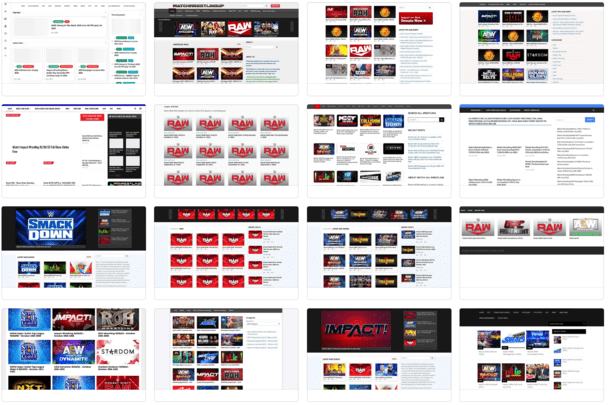
And then there are the look-a-likes, clones, and other variants that look like WatchWrestling, many with similar domains, that either carry exactly the same or substantially the same content. It may transpire that some of these are destined to be handed over to ACE, the truth is we just don't know.

Cut-and-paste, internet litterwatchwrestling-clones

At times like these, the scale of the task ahead for groups like ACE comes fully into perspective. Still, taking 250+ million annual visits out of the market is still a massive achievement.

Not quite on the level of events back in nineteen ninety eight when The Undertaker threw Mankind off Hell in a Cell and plummeted sixteen feet through an announcer's table, but Rome wasn't built in a day.

From: TF, for the latest news on copyright battles, piracy and more.

270x90-blue

Are you looking for a VPN service? TorrentFreak sponsor NordVPN has some excellent offers.


Powered by Mad Mimi®A GoDaddy® company

Thursday, October 26, 2023

TorrentFreak's Latest News


Record Labels Shut Down FileWarez, Brazil's Oldest Pirate Forum
Andy Maxwell, 26 Oct 10:23 AM

filewarez-goneAt a time when an older generation of file hoarders were still coming to terms with the disappearance of BBS-based communities, new friendships were being built in support of the next big thing.

Peer-to-peer technologies such as Napster, Gnutella, FastTrack, and BitTorrent, revolutionized file-sharing but without the support of dozens of thriving forum-based communities, where people shared P2P tutorials, tips, news, and each other's company, things may have gone quite differently.

Still, having served their purpose, many forums found themselves deserted too, their members lured away by the temptations of social media. Others were just getting started.

19+ Years Ago, FileWarez Was Born

As far as we know, Brazil-based file-sharing forum FileWarez.com first appeared in August 2004, its domain name having been registered the previous month. The default language was naturally Portuguese and according to this image from the Wayback Machine, potential members needed a basic grip of the language to sign up. After all, Google Translate wouldn't exist for another two years.

filewarez-com 2004

At some point in the years that followed, FileWarez shifted to a Netherlands .NL domain supported by filewarez.no-ip.biz, which may suggest a site regularly on the move. In 2008, unspecified problems saw the .NL domain dumped in favor of a new one.

Riding out problems, various issues, and bouts of downtime, FileWarez.tv stayed in place for the next 15.5 years. Then two weeks ago, after establishing itself as Brazil's oldest file-sharing forum, FileWarez suddenly vanished.

Left in the Dark

When the main forum went down, other discussion platforms linked to FileWarez went down too. With its Discord and Telegram channels consigned to history, coupled with earlier news of a staff member passing away, not even the site's moderators were able to provide solid information.

On Facebook, however, a post indicated that the site had been taken down by its operator. Sooner or later, the post predicted, the site would be targeted by law enforcement so in anticipation, all site data had already been deleted, to protect staff and users.

"Thank you very much for all these years of sharing, a big hug and may this message find you well."

IFPI Announces Demise of FileWarez

In a press release Wednesday, global music industry group IFPI announced that "prominent illegal file-sharing forum, FileWarez," was shut down following co-ordinated action by record companies, anti-piracy body APDIF, and local cybercrime unit, Cyber Gaeco.

"IFPI, the organization that represents the recorded music industry worldwide, alongside its Brazilian national group Pro-Musica, have welcomed the successful action against FileWarez.tv – one of the most prominent illegal file sharing sites in Brazil – by the Brazilian special cybercrime unit of prosecutor's office of São Paulo, Cyber Gaeco," the announcement reads.

"FileWarez was the most established illegal filesharing forum in Brazil, dedicated to sharing illegal music content. While active, the site had more than 118,000 registered users with at least 24,000 monthly active users."

Celebrations and Disappointment

"We congratulate Cyber Gaeco on their action," added Melissa Morgia, IFPI's Director of Global Content Protection and Enforcement.

"The site operated with no regard for the rights of music creators and has undermined the legal marketplace in Brazil. This is an important action in the continuing fight against piracy in the country."

For former members with fond memories, both the community and what the site offered will be sorely missed.

"I joined FW in mid-2013, I couldn't believe it when I saw the organization, the care and especially the safety. Something truly done by the community for the community," a former member wrote on Reddit.

"Being able to consume films, series, games and software that I could not afford to access at the time through official means in such a simple and safe way was magical. I fell in love with [FileWarez] from the first access. If it's gone for good, it will be greatly missed, I hope not, but still, thank you very much for everything FileWarez and your amazing community!"

Replacements or Opportunists?

Links to alleged FileWarez clones and similar replacements present a dilemma for former users, especially those who can't accept it's all over. The temptation to check out similar-sounding domains might be strong, those listed below, for example.

FileWarez - APDIF

Demonstrating perfectly that anyone can buy a lookalike domain, all of the above were registered on October 17 by APDIF, one of the anti-piracy groups responsible for taking FileWarez down.

It could've been worse.

From: TF, for the latest news on copyright battles, piracy and more.

Instagram and Facebook 'Flag' IPTV Searches Over Piracy Concerns
Ernesto Van der Sar, 25 Oct 09:57 PM

meta logoSimilar to any other online platforms that deal with user-generated content, Instagram and Facebook process thousands of copyright complaints daily.

Simply responding to takedown notices isn't sufficient for all rightsholders, some of which mentioned Meta's companies as potential "notorious markets" in recent recommendations to the U.S. Trade Representative (USTR).

Meta Rebuts Notorious Markets Claims

Meta is not happy with this and this week the company responded with a rebuttal. For starters, it points out that the USTR's Special 301 process is intended to map foreign copyright threats, not domestic ones. That would mean that as an American corporation, Meta has no place in the review.

Zuckerberg's company writes that it fully supports the USTR's Notorious Markets List as a means to flag global piracy and counterfeiting threats, but expanding it to domestic companies goes beyond its scope.

"[I]f the Notorious Markets List is to continue to advance U.S. trade interests internationally, it needs to remain focused on the underlying purpose of the Special 301 program: the identification of foreign countries and foreign markets that engage in or facilitate piracy and counterfeiting."

Notorious?

Many Anti-Piracy Tools

Meta doesn't stop there. It continues the rebuttal by outlining the wide variety of anti-piracy and counterfeiting measures it has implemented over the years.

Both Instagram and Facebook have anti-piracy tools that go far beyond the basic notice and takedown procedures required by law. This includes automated content recognition technology, for example, as well as an elaborate Intellectual Property Reporting API.

Instagram also blocks hashtags linked to potentially problematic content. For example, the #Z-Library hashtag doesn't seem to exist, and tagging posts with #IPTV doesn't lead anywhere either.

According to Meta, these types of interventions are meant to reduce the discoverability of potential copyright-infringing content. In the case of the hashtag blocks, it also allows Instagram to automatically disable accounts that repeatedly use these forbidden words.

Anti-Piracy Popup

Meta's rebuttal mentions that it recently added a new 'intervention' technique to its arsenal. To reduce piracy and counterfeiting, both Instagram and Facebook now show popups to users who search for controversial terms.

It's unclear how many problematic terms Meta identified, but "luxury replica" and "IPTV" are explicitly mentioned.

"Now, when users enter certain counterfeit- and piracy-related terms […] into the search bar on Facebook or Instagram, they are directed to a pop-up that explains Meta's policy against IP infringement and offered a link to Meta's IP Help Center to learn more," Meta writes.

You Sure?

are you user

Facebook and Instagram users can still reach the search results if they want, but Meta believes that this nudge will help to educate users where needed.

"Only after users see this pop-up can they click through to see the results of their search. By adding this layer of friction, we are able to reduce users' engagement with potential counterfeit and pirated content – all while providing further education and transparency," Meta clarifies.

Just how effective these and other tools are is unknown. Meta probably collects data on how people interact with these roadblocks so it would be great – from a transparency perspective – to learn what the click-through rate is.

All in all, Meta believes that all the efforts it takes to combat piracy, should make it clear that their platforms should not be labeled as 'notorious piracy markets', even if they were foreign services.

—

A copy of Meta's full rebuttal, which it sent to the USTR a few days ago, is available here (pdf)

From: TF, for the latest news on copyright battles, piracy and more.

270x90-blue

Are you looking for a VPN service? TorrentFreak sponsor NordVPN has some excellent offers.


Powered by Mad Mimi®A GoDaddy® company