Friday, May 29, 2020

TorrentFreak's Latest News


US Court Hands Down Preliminary Injunction Against Pirate IPTV Provider
Andy, 29 May 10:12 PM

IPTVPirate IPTV services have flourished in the past few years with little to hold them all back.

To counter the threat, however, US-broadcaster DISH Network hasn't taken its foot off the gas, filing numerous lawsuits in local courts in an effort to shut at least some of them down.

DISH seems to pick its targets wisely, enjoying success in many of not all of its lawsuits. This week the company added another victory to its collection after obtaining a preliminary injunction to prevent a pirate IPTV service from infringing its rights.

Filed under seal back in late January at a Florida court, the complaint targeted Robert Reich, an alleged resident of Riviera Beach, Florida. Reich's IPTV service reportedly operates under various business names including Channel Broadcasting Corporation of Belize Ltd, Channel Broadcasting Cable, CBC Cable, and CBC.

The 'Pirate' Rebroadcasting Scheme

According to DISH, Reich is the owner and operator of the 'CBC X-View Cable Service' which does business at CBC.bz. DISH alleges that the service is actually a pirate TV operation that utilizes official DISH subscriber accounts (many of which have Florida addresses) to steal the company's programming before retransmitting it via the Internet.

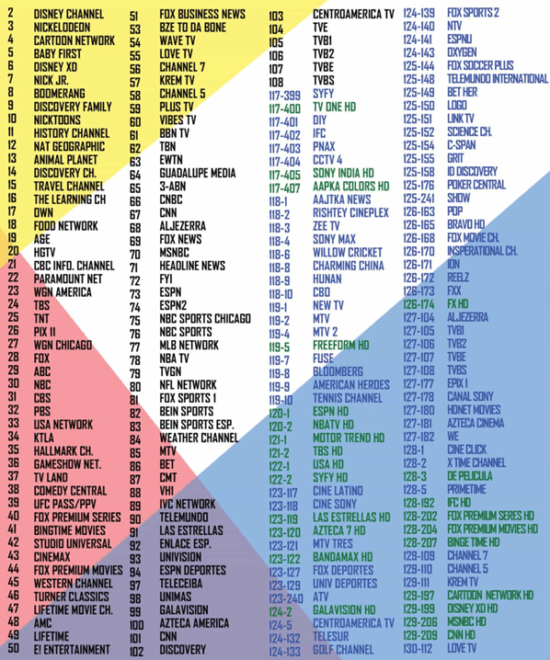
The image below shows around half of the channels offered by the service, many of which are licensed exclusively by DISH.
"Defendant sells subscriptions to the CBC pirate television service for $60 per month plus a $55 installation fee. To purchase a subscription, customers can contact CBC through a variety of means according to CBC's website, including telephone, email, Facebook, and WhatsApp VOIP service," the complaint reads.

In addition to regular subscribers, DISH alleges that the service is also being used in several hotels in Belize including the Radisson Fort George. DISH claims that error messages from its services were observed on television sets in the hotels showing that the programming had indeed been retransmitted from its platform.

DISH commonly files anti-IPTV lawsuits under copyright law or the Federal Communications Act, with the latter being used in this case. The company alleges breaches of 47 U.S.C. § 605(a) and 47 U.S.C. § 605(e)(4) which covers the sale of device codes (aka subscriptions) and piracy devices such as configured set-top boxes.

Statutory damages of between $1,000 and $10,000 are available for each violation of Section 605(a) and up to $100,000 if the violation was committed willfully and for financial gain. Section 605(e)(4) allows for statutory damages up to $100,000 for each violation.

Defendant Tracked Down and Served in Belize

The docket shows that on April 24, 2020, a former police officer and process server hired by DISH served documents on Robert Reich at his residence in Belize, including an ex parte motion for temporary restraining order and motion for preservation order and asset freeze previously granted by the court.

In response, Reich filed a motion to quash, arguing that the court that it had no jurisdiction over him because he hadn't been properly served. After highlighting conflicting statements submitted by Reich and his wife, earlier this month Judge Rodney Smith dismissed the motion and sided with DISH.

Temporary Restraining Order Converted to Preliminary Injunction

This week the court noted that it had previously granted a temporary restraining order (TRO) against Reich based on several findings, including that since DISH was likely to succeed in its claims under the FCA, the continued distribution of pirate subscriptions and devices would cause "irreparable injury" to the company.

Since then, however, the court acknowledged that the parties had met and agreed to convert the TRO into a preliminary injunction to be formalized by the court, in advance of an upcoming hearing.

As a result, Judge Smith was happy to carry that out by restraining Reich and all of his businesses from continuing to infringe DISH's rights. That includes receiving and/or distributing DISH programming without permission and selling or distributing devices "marketed, designed or intended for receiving or assisting others" in receiving DISH programming.

Reich was further restrained from destroying, hiding or transferring any computer servers, satellite equipment, software, set-top boxes and documentation that have been used (or could be used) to support his pirate IPTV service.

Finally, Reich had severe restrictions placed on his assets, including physical items, cash and bank accounts, preventing any transfer beyond what's required for "reasonable" living and business expenses. The court told Reich that he must now "keep detailed records" of all his expenditures.

"Defendant, and anyone acting in active concert or participation with Defendant or Defendant's CBC TV Service at issue in this action who receives actual notice of this Order, is warned that any act in violation of any of the terms of this Order may be considered and prosecuted as contempt of this Court," Judge Smith warned.

The complaint and supporting documents can be found here (1,2,3,4 pdf)

From: TF, for the latest news on copyright battles, piracy and more.

US Copyright Office's DMCA Tweaks Trigger 'Internet Disconnection' Concerns
Ernesto, 29 May 12:58 PM

After several years of public consultations and stakeholder meetings, the US Copyright Office issued its review of the DMCA's safe harbor provisions.

The report doesn't propose any major overhauls of the DMCA. Instead, it aims to fine-tune some parts, to better balance the interests of copyright holders and online service providers (OSPs).

More drastic suggestions were put on the backburner. Those include pirate site blocking and a 'takedown and staydown' requirement for online services, which would require mandatory upload filtering.

Not Everyone Is Happy with the Report

The Copyright Office's attempt to create more balance is well-intended but not everyone is pleased with it. For example, a statement released by several prominent music industry groups, including the RIAA, shows that they wanted and expected more.

The music groups provide a list of things big technology platforms could do to address the concerns raised in the report. However, their first suggestion is to ensure that 'takedown' means 'staydown.' That's one of the things the Copyright Office explicitly did not recommend, as there may be a negative impact.

On the other side, there was a lot of critique of the apparent disregard for a key party in the DMCA debate, the public at large. The Copyright Office frames DMCA issues as a 'copyright holders' vs. 'online service provider' debate, but the voice of the public is glanced over at times.

Looking at the suggestions in the report, however, it's clear the public will be heavily impacted by the proposed changes. This is also a problem signaled by some digital rights groups.

Disconnecting Alleged Copyright Infringers

According to Public Knowledge, the Copyright Office's recommendations are ill-considered. The digital rights group believes that the report heavily favors copyright holders while totally overlooking the interests of millions of regular Internet users.

The proposals don't only harm the general public, they also fail to recognize copyright abuses, including false DMCA notices, the group adds.

"In a contentious debate, it comes down on the same side (copyright holders) in nearly every instance, and disregards ample evidence that the DMCA is often abused by people looking to censor content they have no rights over," the group notes.

Public Knowlege takes offense to the Office's comments regarding repeat infringers. These stress that people's Internet access be disconnected based on allegations of copyright infringements by copyright holders.

"Astonishingly, the Copyright Office buys into the idea that users should be subject to being cut off from internet access entirely on the basis of allegations of copyright infringement," Public Knowledge writes.

The DMCA text is currently not clear on whether allegations are good enough, but the Office's recommendation is backed by an Appeals Court order. Nonetheless, Public Knowledge doesn't believe it should be law.

"Congress should not be making it easier for private actors to completely and unilaterally remove a person's ability to access the internet," the group writes. "The internet is not just a giant copyrighted-content delivery mechanism; it is the fundamental backbone of modern life."

Public Knowledge is not alone in its criticism. The Electronic Frontier Foundation (EFF) also stresses that the interests of the public are largely ignored, tilting the "balance" towards copyright holders.

"For example, the proposal to terminate someone's Internet access—at any time, but especially now—is a hugely disproportionate response to unproven allegations of copyright infringement," EFF wrote on Twitter.

Copyright Office Cherry-Picking?

It's worth noting that court decisions are not always leading to the Copyright Office. The Appeals Court previously ruled that a repeat infringer policy doesn't have to be written down, for example, but the Office now suggests updating the DMCA to change this.

Requiring a written repeat infringer policy, contrary to the Appeal Court ruling, would favor copyright holders. The same is true for confirming the other Appeal Court ruling, which concluded that ISPs must deal with repeat infringers based on allegations alone.

This doesn't mean that the Office is always taking one side, however. As mentioned earlier, the report also denied the top demands from copyright holders by not recommending site blocking and 'takedown – staydown' policies.

Disagreement Remains

By highlighting these positions from two opposing sides of the debate, it is clear that the Copyright Office report includes positive and negative elements for all stakeholders. While it attempts to create more balance, disagreement remains.

This has also been the general theme of the DMCA revision debate over the past several years. The demands from one side usually hurt the other, and vice versa. It took a long time before the Office finalized its views and given what's at stake, pushing any changes through Congress is not going to be easy.

From: TF, for the latest news on copyright battles, piracy and more.

 
 
Powered by Mad Mimi®A GoDaddy® company

Thursday, May 28, 2020

TorrentFreak's Latest News


YTS Bypasses Security Warnings with Simple URL Update
Ernesto, 28 May 08:20 PM

The Internet is full of threats. To help people steer clear from trouble, Google launched its Safe Browsing tool in 2012.

This service marks problematic websites when there are potential malware and phishing problems. This information can then be used by third-parties to take action.

In the past, several popular pirate sites have been flagged. These issues are usually caused by malicious advertisers. The operators of the sites get a heads up form Google, and after the problem is addressed, the flag is removed.

YTS Pages Were Blocked by Chome and Firefox

Last weekend, YTS had first-hand experience of this process. The torrent site, which serves millions of people per day, was branded a 'phishing' threat by Google.

As a result, Chrome and Firefox blocked users from directly accessing some pages on the site. While the homepage showed no issues, the movie detail pages returned a full-screen red warning, cautioning people to stay away.

Firefox warning YTS

Needless to say, these types of warnings will have a negative impact on the site's traffic, whether they are warranted or not. In other words, fixing the issue should be a high priority for the site's operator.

And indeed, when we visited YTS today everything had returned to normal. Or so it seemed. The movie detail pages no longer threw up any warnings and downloading .torrent files worked just fine.

Simple Trick Makes Security Warnings Disappear

While this might appear to be a matter of 'case solved', taking a closer look at the site reveals a tiny but important change. The movie detail pages are no longer linked from a /movie/ subdirectory, but from /movies/, as shown below.

TPB afk on YTS extra s

Adding an 's' to the URL appears to be insignificant but, in this case, it's not. Apparently, this extra letter is the reason why users no longer see any warnings. The old URLs, without the 's' remain blocked.

It seems odd that a site can bypass Google's elaborate Safe Browsing tool by simply updating a URL, but it works. A quick check in the Safe Browsing tool confirms that the new link to YTS.mx/movies is clean, while the old YTS.mx/movie link is still 'unsafe.'

Whether YTS also tackled the underlying problem is unknown. However, we assume that the new links will eventually be flagged too if the issue persists.

Enhanced Safe Browsing?

The bypass trick comes just a few days after Google announced that it had started rolling out an 'enhanced Safe Browsing' for Chrome users. This has nothing to do with the YTS issues, but Google's intro is worth noting.

"Over the past few years we've seen threats on the web becoming increasingly sophisticated. Phishing sites rotate domains very quickly to avoid being blocked," Google wrote.

We wouldn't classify the addition of extra letter in the URL as 'sophisticated,' but it certainly helped to get rid of the security warning.

From: TF, for the latest news on copyright battles, piracy and more.

Russia Adopts Law to Block Pirate Apps and if Necessary, App Stores Too
Andy, 28 May 10:13 AM

Pirate AppleAs torrent indexes and streaming portals continue to provide access to copyrighted content, there has also been a considerable increase in the availability of software applications that facilitate access to movies, TV shows and similar content.

These tools, which can be installed with minimal effort, often act as aggregators of content and presenting it in easy-to-use interfaces on mobile phones, tablets and similar devices. While the sources for this content can be handled with traditional takedown and blocking mechanisms, authorities in Russia have been seeking to take direct action against the apps themselves.

Following its third reading, Russia's State Duma adopted new legislative amendments yesterday that will allow them to do just that.

How the New Law to Tackle Piracy Within Apps Will Work

After receiving a complaint from a copyright holder, local telecoms watchdog Roscomnadazor will have 72 hours to determine where the allegedly-infringing application is being hosted. This might typically be an official repository such as Google Play or Apple's App Store but could also be a third-party distributor or website offering a similar service or functionality.

Roscomnadzor will then send an infringement notice to the platform informing it of the alleged violation while highlighting a requirement to limit the availability of the content identified in the notice. The app distribution platform will then have 24 hours following the receipt of the complaint to notify the application's owner that an infringement complaint has been filed.

Within 24 hours of the developer being made aware of the details of the complaint, they will be required to prevent the specified content from being made available in their application. If they do not comply, the responsibility to prevent ongoing infringement will then fall back on the app distribution platforms themselves, requiring them to stop distributing the entire application.

In the event that the application distributor fails to take the mandated removal or blocking steps, Roscomnadzor will then be able to issue an instruction to have the distributor itself blocked by all Internet service providers in Russia, thereby preventing consumers from having access to the platform in its entirety.

"If the owner of the information resource [Google Play, Apple's App Store] has not limited access to the software application, the information necessary for taking measures to restrict access to the software application is sent to telecom operators," an announcement from the State Duma reads.

Last-Ditch Efforts to Soften the Law Were Ignored

In the original draft of the legislation, responsibility for blocking access to pirated content was limited to the developers/operators of the allegedly-infringing applications themselves. However, subsequent amendments expanded liability to application distribution platforms too.

Several trade groups made last-minute appeals to the State Duma requesting that measures to block distribution platforms be removed from the legislation but their calls went unheeded. As a result, there are now fears that key app distribution players could be negatively affected by the measures due to additional requirements to monitor for the alleged infringements of third-parties.

After two years in the making, the new law will be signed by President Vladimir Putin and into force on October 1, 2020.

From: TF, for the latest news on copyright battles, piracy and more.


Powered by Mad Mimi®A GoDaddy® company

Wednesday, May 27, 2020

TorrentFreak's Latest News


Vapor Store Looks a Lot Like a Popcorn Time For Pirated Steam Games
Andy, 27 May 08:38 PM

Vapor StoreWebsites are some of the most popular hangouts for pirates but over the past several years there's been an increased appetite for app-based solutions.

Modified Kodi installations, for example, have proven popular for close to a decade but in 2014 Popcorn Time sparked a revolution by providing a Netflix-like experience for movie and TV show consumers.

Since then, dozens of Popcorn Time-like applications have appeared on the scene with varying levels of success but most have stuck to providing access to video content. This week, however, a new tool called Vapor Store debuted online targeting the video games niche.

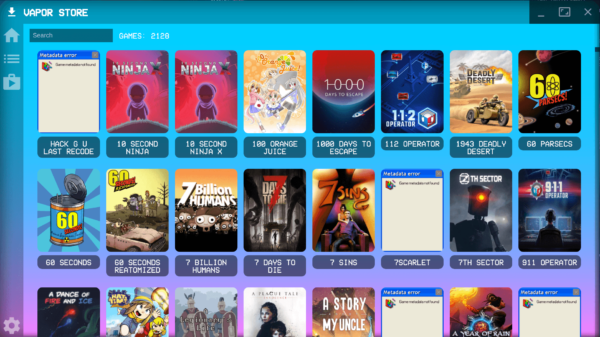
As the image below shows, a fully-configured Vapor Store looks very much like a Popcorn Time for pirated games.

Vapor Store

Speaking with TorrentFreak, Vapor Store developer 'Sushy' (who appears to be still at school) says that he'd always liked the idea of having a simple-to-use program to download games. So, putting his newly-acquired coding skills to the test, he embarked on this "challenging and rewarding" open-source project.

"Vapor Store is a program that simplifies downloading and installing games on Windows," Sushy informs TF.

"All games are direct downloads [not torrents as is the case with Popcorn Time] and to use Vapor Store you will need to find a source that already has a list of games with download links and import them into Vapor Store. Vapor Store will generate a list based on the data from the site the user inserted."

For legal reasons, this step is pretty important. While Popcorn Time comes ready-configured with all pirate sources and resources, Vapor Store does not. Users are required to input a source site to render it useful and it's already an open secret that the software currently only works with video game download site Steamunlocked.

Once connected to that site, Vapor Store utilizes the database at IGDB, presenting game titles, previews and screenshots along with cover art.

Vapor Store meta data

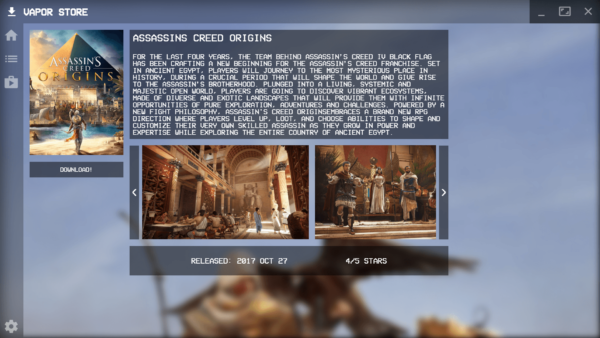
"When you click on a game you get even more information such as a short description and some screenshots. To install a game the user simply needs to click on the 'Download' button and then Vapor Store will do its thing," Sushy explains.

"Once the install is complete the game will automatically get added to the user's library and from there they will be able to run the game."

Vapor Store is still very much in development over at Github, with updates to its interface, storefront and ability to work with ROM sites on the horizon. The developer acknowledges that there are things still to be fixed but believes the tool has reached the stage where it can be tested by the public.

Vapor Store is currently limited by the slow download speeds associated with file-hosting sites and due to the nature of games themselves (which cannot be streamed in the same way video can), it does not enjoy the immediacy of its movie and TV show equivalents. From a technical perspective, people shouldn't begin holding their breath anytime soon for that kind of functionality.

That being said, Vapor Store is an interesting concept that could be built upon in the future. It's no Steam replacement at this early stage but has the potential to spark plenty of curiosity.

From: TF, for the latest news on copyright battles, piracy and more.

Stores Selling Switch Piracy Hacks 'Disappear' Following Nintendo Lawsuit
Ernesto, 27 May 11:22 AM

Hacking group Team-Xecuter has long been a thorn in Nintendo's side.

The group offers hardware and software solutions that allow people to install and play pirated games on Nintendo consoles, including the popular Nintendo Switch.

After cracking Switch's original technical protections in 2018, Team-Xecuter is now gearing up to release a hack for newer versions as well as the Switch Lite. But while Nintendo's efforts to take down the hacking group have failed thus far, the game company isn't sitting idly by.

Last week it filed two lawsuits in US federal courts, targeting a total of nine websites. These include Uberchips.com, USAchipss.com, NC-card.com and Flashcarda.com which, according to Nintendo, are official resellers of hacking tools.

While it can be hard to shut down sites through legal action, especially if they are operated and sell products from outside of the US, in this case Nintendo's strategy has already paid off. Or so it appears.

Switch Piracy Hack Stores Disappear

Soon after the news about the lawsuits was made public, several stores began to disappear. This includes Uberchips.com which, according to the complaint, is operated from the US by Ohio resident Tom Dilts Jr.

Initially, Uberchips removed all listings of Team-Xecuter hacks, referring to some unnamed issues. Soon after, however, the store completely disappeared showing just a blank page instead.

People who preordered the new SX Core and SX Lite chips won't get them delivered. According to customer reports the website will issue refunds, but most just want the chips.

"Very disappointed to receive email from uberchips.com saying that they are issuing full refund and are no longer processing any pre-orders. Where else am I able to order from that ships to Canada?" one customer wrote.

Uberchips is not the only site to throw in the towel, several other stores have vanished too.

google hosting error
At the time of writing the Mod3dscards.com domain links to a parked page, while NX-card.com, Flashcarda.com, USAchipss.com, and Anxchip.com all point to a Google hosting error, suggesting that the sites were removed.

New Hack Stores Surface

Meanwhile, there is no official word from Team-Xecuter on the lawsuits. Interestingly, the site still lists "recommended seller" banners for some of the sites that are down. However, these banners now link to new URLs that offer pretty much the same products.

recommended team-xecuter sellersFor example, the Flashcarda.com banner links to Free-switch.com, which looks very similar to the original site.

The Mod3dscards.com banner is also still up, but the link is now pointing to Mod-switch.com.

In addition, three of the sued sites – TXswitch.com, SXflashcard.com and Axiogame.com – are still online and accepting orders.

For now, none of the targeted sites has responded in court. While some foreign operators may choose to ignore the case, the US-based operator of Uberchips.com has been summoned already and will have to appear in court or face a default judgment.

Although the lawsuits have clearly had some effect, Team-Xecuter hacks and mods remain widely available. But by going after resellers, Nintendo may be able to get a step closer to the source of the problem.

From: TF, for the latest news on copyright battles, piracy and more.


Powered by Mad Mimi®A GoDaddy® company