Wednesday, November 27, 2019

TorrentFreak's Latest News


Telegram Faces Anti-Piracy Referral to US Over Cryptocurrency Plans
Andy, 27 Nov 05:05 PM

Telegram was founded in 2013 by brothers Nikolai and Pavel Durov, who previously launched Russian social network VK (vKontakte).

The messaging service has grown from strength to strength and currently has around 300 million users. However, Telegram is increasingly associated with the spread of copyright-infringing material, as highlighted in October by the RIAA.

"Telegram offers many user-created channels which are dedicated to the unauthorized distribution of copyrighted recordings, with some channels focused on particular genres or artists," the RIAA wrote in its submission to the USTR.

While one submission to US authorities is problematic, Telegram could soon face a few more coming from Russia itself, where a court order exists to prevent ISPs from providing access to the service. The threat comes from the Internet Copyright Protection Association (AZAPI) which represents copyright holders including some of the largest book publishers.

AZAPI says it has identified at least 170 Telegram channels that help to distribute pirated content to an audience of several million users. A letter reportedly sent by AZAPI to Telegram (obtained by local news outlet Kommersant) has the anti-piracy outfit complaining that most channels, and indeed Telegram itself, are not responding to copyright complaints.

It's a position shared by Aleksey Byrdin, Director General of the Internet Video Association.

"Since 2016, we have repeatedly encountered the absolute neglect of the Telegram administration to the claims of copyright holders on audiovisual content," Byrdin says.

As a result, AZAPI wants Telegram to introduce digital fingerprinting technology to assist with the identification and removal of allegedly infringing content. However, the whole matter is being further complicated by Telegram's cryptocurrency business plans.

According to AZAPI, Telegram's upcoming TON Blockchain network (and its token 'gram') "will be an ideal tool for monetizing counterfeit content on an anonymous basis."

As a result, if anti-piracy measures aren't taken, AZAPI says it will be left with no choice but to file complaints with the US Chamber of Commerce, the SEC, the Financial Action Task Force on Money Laundering (FATF) and the American Book Publishers Association.

Whether any such referrals can deepen the quagmire Telegram already finds itself in the US is another matter, however.

On October 11, the SEC announced that it had "filed an emergency action and obtained a temporary restraining order against two offshore entities conducting an alleged unregistered, ongoing digital token offering in the U.S. and overseas that has raised more than $1.7 billion of investor funds."

The two companies – Telegram Group and TON issuer – filed a response to the SEC just a day later, requesting that the court throw out the SEC's case.

Source: TF, for the latest info on copyright, file-sharing, torrent sites and more. We also have VPN reviews, discounts, offers and coupons.


BREIN Wins Court Case Against Prolific Torrent and Usenet Uploader
Ernesto, 27 Nov 09:17 AM

Dutch anti-piracy group BREIN has targeted operators and uploaders of pirate sites for more than a decade.

The group frequently approaches alleged wrongdoers with a proposal to settle the matter privately, but it doesn't shy away from going to court if needed.

This is what happened to a prolific uploader of torrents and Usenet files. The man was connected to Place2home, a piracy community that was dismantled by BREIN last year. At the time, several operators settled the matter privately, but the uploader didn't.

This prompted BREIN to take the man to court where he stood accused of sharing hundreds of gigabytes of pirated films and series. These were uploaded using aliases including "Starlight" and "Serie-Team."

According to Dutch court records, the man was also active as an operator of both Place2home.org and Place2home.net, which offered Usenet and torrent files respectively.

In his defense, the man, whose name is abbreviated to "Van S," admitted that he uploaded files. However, he denies that this happened on the scale and with the volume BREIN claimed. According to 'Van S,' his role was minimal as others were posting under the same aliases.

After reviewing the available evidence, the Utrecht Court sided with BREIN. It concluded that "Van S" was more than "an occasional" uploader and that he was also involved in operating the sites.

Part of the evidence comes from a WhatsApp chat log where 'Van S,' using the "Starlight" alias, admits to uploading movies and TV-series totaling 500 gigabytes in February of last year. The same chat also shows that he was well aware of the infringing nature of these files.

Based on this and other evidence the Court concludes that 'Van S' shared infringing content on a large scale between 2013 and 2018. In addition, he facilitated copyright infringement through his role as sysop of the two Place2home sites.

The verdict doesn't cover any damages, but 'Van S' is ordered to pay BREIN's legal fees, which total over €13,000. In addition, the man is required to remove his uploads and provide information about others who were involved with Place2home. The latter is important, as it may lead to additional suspects.

Failing to comply with the order will come at a high price. The Court notes that 'Van S' must pay a penalty of €5,000 per day that he doesn't come forward, with a maximum of €150,000.

BREIN director Tim Kuik is happy with the outcome. The verdict shows that, in addition to uploaders, site operators can be held responsible as well. This is in line with the EU Court of Justice's ruling in The Pirate Bay case, Kuik informs TorrentFreak.

The Place2home bust itself has also proven to be useful in the broader scheme of things. According to BREIN, it revealed that people higher up the chain were involved as well. This includes reseller Newsconnection, which offered subscriptions to Usenet provider XSnews.

"According to statements of uploaders who already settled, the sites were financed by people up the chain," Kuik tells TorrentFreak.

These uploaders also shared internal communication which backed this up. That includes WhatsApp conversations, which also appeared as evidence in the most recent court case.

"To us, it is evident that the various players on the commercial Usenet market are colluding to optimize the availability of popular content on Usenet. This is completely different from the original Usenet," Kuik notes.

BREIN believes that Usenet resellers and providers profit from piracy, and not just indirectly. In some cases, they are financing pirate sites as well, in order to keep their businesses profitable. With information from people such as 'Van S,' BREIN hopes to document these connections.

"We believe that the money makers on Usenet who are pretending to be ignorant are in fact are fully aware of what pays the bills: access to unauthorized content. They are facilitating it and financing it," Kuik says.  

—

A copy of the verdict from the Utrecht Court is available here, in Dutch (pdf).

Source: TF, for the latest info on copyright, file-sharing, torrent sites and more. We also have VPN reviews, discounts, offers and coupons.

 
 
Powered by Mad Mimi®A GoDaddy® company

Tuesday, November 26, 2019

TorrentFreak's Latest News


Movie Pirate Pleads Guilty, Faces Five Years in Prison, Forfeits Millions of Dollars
Andy, 26 Nov 05:07 PM

In October 2013, Homeland Security Investigations (HSI) agents received information from PayPal concerning two 'pirate' websites, Noobroom.com and Noobroom7.com.

For a fee, the sites allowed subscribers to stream movies and TV shows, which was of particular interest to the MPAA. Their investigation concluded that the platforms distributed works in breach of their members' copyrights.

In July the following year, the MPAA sent a cease-and-desist notice to Noobroom but within days, the site shifted its users to a new site, SuperChillin.com. The MPAA determined that the platforms – plus another pair named as Movietv.co and SitPlay.com – were operated by Oregon resident Talon White.

With White under suspicion of copyright and money laundering offenses, last November a magistrate judge in Oregon approved a search and seizure warrant targeting millions in cash and cryptocurrency.

On Monday, the Department of Justice revealed that after netting more than $8 million from his piracy activities, Talon had pleaded guilty to one count each of criminal copyright infringement and tax evasion.

According to the Department of Justice, White underreported his income by more than $4.4 million from 2013 through 2017, resulting in a willful underpayment of $1.9 million in taxes.

The penalties faced by White are severe. On top of a potential five years in prison, a $250,000 fine, and three years' supervised release on each of the two charges, the financial implications are already massive.

White has entered into a plea agreement which will see him forfeit $3.9 million seized from his bank accounts, $35,000 in cash, cryptocurrency worth around $424,000, plus his home in Oregon, currently valued at $415,000.

On top, he must pay $669,557 in restitution to the MPAA and $3,392,708 in restitution, which includes penalties and interest, to the IRS.

White will be sentenced on February 21, 2020, before U.S. District Court Judge Ann L. Aiken. In the meantime, however, the case raises additional interest in at least two other directions.

A case revealed at the weekend in New Zealand appears to have some similarities with White's. Both involve a pirate movie site in the US, both received a PayPal referral for suspicious activity, and both resulted in the seizure of large volumes of cash and cryptocurrency.

Finally, the involvement of the IRS in a criminal copyright infringement case raises questions about what lies ahead for Gears Reloaded founder Omar Carrasquillo, aka YouTube OMI IN A HELLCAT.

Last week, he reported that he'd been raided by several FBI officers and a single IRS agent who seized "pretty much everything", including millions of dollars, a huge car collection, and a large collection of jewelry. Ever since he's been posting videos on the topic, one of which included a brief glimpse of a purported search a seizure warrant issued by a court in Pennsylvania.

Carrasquillo insists that what he did in respect of IPTV isn't a crime in the United States but concedes that he didn't pay his taxes in a timely manner and he's learned his lesson. He hopes that the money seized will cover his back taxes but still expects to spend some time in prison.

Source: TF, for the latest info on copyright, file-sharing, torrent sites and more. We also have VPN reviews, discounts, offers and coupons.

TekSavvy Appeals First Canadian Pirate Site Blockade
Ernesto, 26 Nov 11:01 AM

Two weeks ago Canada's Federal Court approved the first pirate site blockade in the country.

Following a complaint from major media companies Rogers, Bell and TVA, the Court ordered several major ISPs to block access to domains and IP-addresses of the pirate IPTV service GoldTV.

While the service in question has a relatively modest number of users, the order paves the way for additional site blocking requests that may target traditional pirate sites as well.

This is exactly what major rightsholders have extensively lobbied for in the past. After a request for a national pirate site blocking scheme was denied last year, the media companies have now accomplished this goal through the courts.

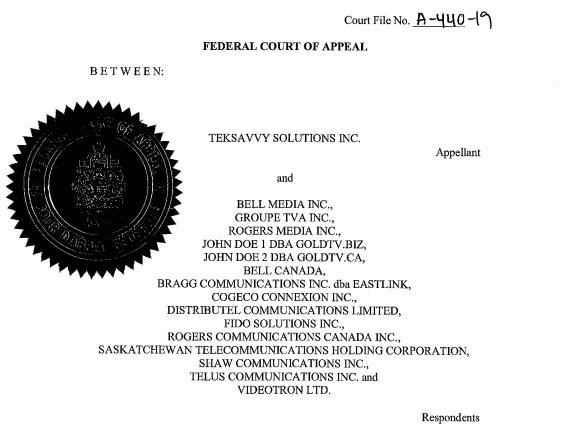
Most Internet providers, which include Bell and Rogers as well, haven't objected to the request. However, there's one that's pushing back. According to TekSavvy, site blocking will do more harm than good and the company filed an official appeal yesterday.

"We are very concerned about what the federal court's new site-blocking regime means for the open Internet as a whole," says Andy Kaplan-Myrth TekSavvy's vice-president of regulatory affairs.

TekSavvy argues that the Federal Court reached the wrong conclusion and asked for the order to be set aside. One of the problems, according to the ISP, is that the Court heavily relied on a UK ruling, instead of merely following Canadian law.

The ISP further highlights that it runs counter to Canada's Net Neutrality principles.

"[The order] is based on foreign law, and it clearly violates Network Neutrality, without giving any serious consideration to that fundamental principle of communications law in Canada," Kaplan-Myrth tells TorrentFreak.

"If it is allowed to stand, this site-blocking order will be just the first of many, undermining the open Internet to protect the profits and business models of a handful of powerful media conglomerates," he adds.

TekSavvy is the only ISP to file an appeal but, outside court, there has been strong opposition from others. Canadian law professor Michael Geist, for example, has criticized the ruling, arguing that the Government should weigh in on such a crucial matter.

"In reviewing the GoldTV ruling, it is obvious that site blocking raises so many issues that it requires a government policy decision, not a single judge making a myriad of policy calls," Geist noted.

There also many people who see site blocking in a more positive light. Hugh Stephens, Executive Fellow at the University of Calgary's School of Public Policy, says that "copyright protection in Canada has taken a step forward."

Meanwhile, the Federal Court's order has already resulted in the first blocks. Several people are reporting that their ISPs have started to roll out the restrictions already. This includes Rogers, Fido, Bell Aliant, and SaskTel.

It's clear that rightsholders are pleased with the blocking ruling, so they are expected to fiercely defend it at the Federal Court of Appeal. Given the controversy around the site-blocking topic, it would be no surprise if other interested parties will have their say in court as well.

 —

A copy of TekSavvy's Notice of Appeal, filed at the Canadian Federal Court of Appeal, is available here (pdf).

Source: TF, for the latest info on copyright, file-sharing, torrent sites and more. We also have VPN reviews, discounts, offers and coupons.
 
 
Powered by Mad Mimi®A GoDaddy® company

Sunday, November 24, 2019

TorrentFreak's Latest News


Nintendo Wipes 'Piracy Enabling' URLs from Google with Anti-Circumvention Notices
Ernesto, 24 Nov 09:44 PM

As one of the most iconic gaming manufacturers in the world, Nintendo has been fighting piracy for many years.

The company has an in-house anti-piracy division that signals the latest threats to steer enforcement actions in the right direction.

This has resulted in high-profile lawsuits against ROM sites as well as site blocking efforts. For example, earlier this year the company obtained an injunction from the UK High Court which ordered local ISPs to block sites that enable Nintendo Switch piracy.

This included the homes of the infamous Team-Xecutor, as well as sites that sell R4i flashcard adaptors which allow Switch owners to load custom firmware.

The problem for Nintendo is that this blockade is limited to the UK. However, in recent months the company has used another strategy to limit the availability of these sites worldwide, with minimal effort. Instead of going to court, it went to Google.

The gaming company has sent hundreds of takedown notices to the search engine, targeting thousands of URLs. These requests are not standard copyright takedowns. Instead, Nintendo flags the sites for violating the DMCA's anti-circumvention provision.

This includes many pages from Team-Xecuter's site, which offers software to jailbreak the Switch console and bypass other protection measures.

"Nintendo's technological protection measures ('TPMs') ensure that only official copies of its game software can be played on Nintendo's video game systems," Nintendo writes.

"The circumvention devices, products or components offered at the reported links bypass Nintendo's TPMs so that users can play unauthorized copies of Nintendo's game files that are offered unlawfully via the Internet," the notice adds.

Some of the URLs

Nintendo notes that some of the URLs offer circumvention devices and tools directly, but it also highlights pages that "promote and direct" visitors to resellers of the circumvention components.

While Team-Xecuter is one of the main targets, Nintendo is also going after legitimate stores that offer R4i and R4S dongles. This includes Newegg, a well-known electronics retailer based in California.

At the time of writing, Newegg no longer lists any R4i dongles on its .com site but the Canadian version still has some, including the one below. Nintendo also asked Google to remove this page, but for now, it's still listed in the search results.

The same isn't true for many other pages. Most well-ranked Team-Xecuter URLs, including the homepage, have been removed from Google. The same is true for other sites such as usachipss.com, mod-switch.com, mlgames.net, and funnyplaying.com.

Whether the site operators agree with the takedowns or not, they are generally irreversible. Google says that unlike regular DMCA copyright takedowns, there is no counternotice process. The DMCA doesn't prescribe a takedown and counter-notification scheme for DRM circumvention.

While Google has voluntarily chosen to take the URLs offline, it is not required to offer a counter-notice option. This puts targeted sites at a severe disadvantage.

This means that for rightsholders this takedown route can be quite effective. Just a few weeks ago we showed that the RIAA uses the same grounds to remove the URLs of YouTube download platforms, and even scammers have previously used the anti-circumvention route as well.

Source: TF, for the latest info on copyright, file-sharing, torrent sites and more. We also have VPN reviews, discounts, offers and coupons.

Private Internet Access to Be Acquired by Kape
Ernesto, 24 Nov 09:04 PM

Private Internet Access, commonly known as PIA, is one of the largest VPN providers in the world.

In recent years it's become a well-established brand that has had its no-logging policy tested in court, with success.

This week the company announced that some changes are afoot. PIA's parent organization LTMI Holdings is in the process of a merger acquisition by the publicly traded Kape Technologies, which also owns the Cyberghost and Zenmate VPN services.

As part of the planned deal, Kape will pay $95.5 million. Part of this will be paid in cash, Vox reports, and Kape is also planning to pay the $32.1 million in existing debt PIA has on the books.

With the planned merger acquisition Kape hopes to become a dominant force in the VPN industry.

"In one acquisition, I believe we have positioned Kape to fast become one of the leading digital privacy service providers in the world, empowering consumers to manage their own data and digital security," Kape's CEO Ido Erlichman comments.

PIA's CEO Ted Kim is also pleased with the deal and notes that it will help to improve the digital privacy and security of PIA's subscribers worldwide.

There are no changes planned in the short term. The Private Internet Access name will remain in use for now, just as Cyberghost and Zenmate are still using their original brands. However, the acquisition has raised questions among some users.

Some have pointed at Kape's history. The company had previously operated under the name Crossrider and was active in the advertising space. Among other things, it installed toolbars with 'potentially unwanted software.' While the company has since switched to a focus on cybersecurity, this past has made some people suspicious.

In an article addressing some of the questions, PIA assured its subscribers that its course is not going to change. According to Chief Communications Officer, Christel Dahlskjaer, privacy and security remain the top priority.

"From day one, we have been clear that your privacy is our policy and that the Private Internet Access VPN and our other privacy products exist to bring power to the people.

"The people are our stakeholders, and it is to you all, collectively, that we must remain accountable," Dahlskjaer adds. She points out that PIA worked with Kape's to establish a shared mission and guiding principles, which reflects the core values.

It's inevitable that any corporate deal in the VPN industry will be watched closely and that's a good thing. VPN providers rely on trust and should be judged by their actions. The company that protects its customers the best way it can, will ultimately be the most successful.

PIA believes that, by teaming up with Kape, it has the best shot at achieving this goal and asks users to give it the time to prove itself.

—–

Disclaimer: PIA is one of our sponsors. This article was written independently, as all of our articles are. We generally don't report on VPN business news but felt that it was good to mention this development.

Source: TF, for the latest info on copyright, file-sharing, torrent sites and more. We also have VPN reviews, discounts, offers and coupons.
 
 
Powered by Mad Mimi®A GoDaddy® company