Monday, October 3, 2022

TorrentFreak's Latest News


Court Blocks 13,445 'Pirate' Sites Proactively to Protect One Movie
Andy Maxwell, 03 Oct 10:23 AM

BombWhenever rightsholders and anti-piracy groups need more enforcement options, efforts to strengthen or establish new understanding of copyright law are rarely far behind.

In many cases these moves tend to follow a similar pattern – don't ask for too much all at once, dismiss any idea that the internet or 'honest' users could suffer, and then downplay suggestions that new powers represent the thin end of an extremely large wedge.

From being presented as a tool of last resort for use in strictly limited circumstances, site-blocking injunctions are just one example. From humble beginnings they're now available in dozens of countries around the world. A single site in one application was the starting point but today it's not uncommon today to see ten, fifty, or even a hundred.

That shouldn't surprise anyone, nor should the recent efforts to push injunctions into unchartered territory.

Reliance Entertainment: An Early Site-Blocking Pioneer

India began blocking pirate sites in 2011 but the public had no idea it was coming. In an early case, movie company Reliance Entertainment went to court to protect the movie 'Singham' and came away with an order that compelled ISPs to temporarily block sites including Megaupload, Megavideo, Rapidshare, Putlocker, Hotfile and Fileserve.

Having obtained one injunction, to the surprise of no one Reliance Entertainment immediately sought and obtained another. From there, the site-blocking train gathered steam and hasn't looked back.

Indeed, site blocking in India has now reached a point where evidence of actual infringement isn't a priority and in some cases hasn't even happened yet. Nevertheless, courts are still prepared to issue injunctions that include domain suspension orders to businesses in other countries.

Reliance's 'Minority Report' Blocking

Most site-blocking injunctions worldwide are based on evidence of past infringements but for Reliance Entertainment, looking forward has been a persistent theme. The company attempts to predict where its movies may turn up when they're inevitably copied after release, then asks the court to authorize preemptive ISP blocking against a few common offenders. Or at least that's where it started.

After obtaining certification for its new movie 'Vikram Vedha' last Monday, Reliance Entertainment filed an injunction application the next day. The goal was to protect the movie from online piracy following its premiere last Friday. Given that courts in other countries can take months over a decision, the Madras High Court needed to act quickly.

On September 30, the day of the movie's release, the Court published its orders, noting that substantial sums had been invested in 'Vikram Vedha' and the movie was expected to screen in 3,000 cinemas worldwide. With words such as "imminent" and "threat" featured early on, it was already clear which way the judge was leaning.

How far he was prepared to go still came as a surprise.

Reliance Successfully Argued 'Alleged Piracy' in the Future

After reading through the Reliance application, the judge declared that Reliance had made its case and that an injunction was appropriate.

The judge said that if an interim injunction wasn't immediately granted, it would "result in alleged piracy being completed in all and every aspect of the matter." That would in turn lead to an "irreversible situation" and "irreparable legal injury incapable of compensation."

Due to the urgency, the respondents in the case – including 40 internet service providers – weren't notified of the legal action. Nevertheless, the injunction was handed down via two separate orders, which together prohibit anyone from copying, recording, camcording, making available, uploading, downloading, exhibiting or playing the movie without a license.

After specifically prohibiting copying to CD, DVD, pen drives, hard drives or tapes, the orders move on to the issue of ISP blocking. It appears that Reliance asked for a lot and the judge gave them everything.

Thousands of Websites Listed For Immediate Blocking

According to one of the orders, the websites put forward for blocking are all "non-compliant" operations, in that they have no reporting and take down mechanisms in place, at least according to Reliance.

Interestingly, Reliance also informed the court that all of the websites were infringing its copyrights in respect of the movie 'Vikram Vedha', even though it was yet to be released and when the application was filed, no copies were available online. This means that Reliance couldn't have provided any infringing URLs even if it wanted to. Nevertheless, the judge did consider more limited blocking.

"I am also informed that technologically/technically, there is no possibility of blocking that part of the contents of the website which contains alleged pirated version of the suit Movie alone," his order reads.

Ultimately, the judge granted an interim injunction and ordered all of the ISPs (list below) to immediately and proactively block a grand total of 13,445 websites. While the names of the websites were made available to the court, the court did not make the schedule available on the docket.

As a result we have no way of confirming which domains are on the list. The ISPs weren't informed about the injunction application either, so presumably they're also in the dark. The idea that the judge tested all 13,445 domains seems wishful thinking at best.

That leaves Reliance Entertainment as the sole entity with any knowledge of the submitted domains, all of which have been labeled in court as infringing the movie's copyright, even though no copy was available when the application was made.

Overblocking Seems Unavoidable

To put 13,445 sites into perspective, the UK's Police Intellectual Property Crime Unit's 'Infringing Website List' aims to deprive as many pirate sites of revenue as possible after a strict validation process. That list is also a closely guarded secret but at times we know it's featured around 2,800 sites. We believe there are currently around 1,600 sites on the IWL, give or take.

We already know from the injunction application date that none of the domains had the movie (or even a link to it) because a) it hadn't been released yet and b) no copies appeared online until Friday. But beyond that, there is zero chance that all 13,445 sites intended to host or link to the movie and there is zero chance that all 13,445 are "non-compliant" pirate sites.

At least as far as we know, the Department of Communications is yet to publish a formal instruction notice for ISPs to start blocking but that should appear fairly quickly. When it's published we'll certainly be having a very close look and won't be at all surprised to see overreach. The only remaining questions are the scale of the collateral damage and who is affected.

The Madras High Court orders can be found here and here (pdf). ISPs affected by the order below as follows:

1) BHARAT SANCHAR NIGAM LIMITED,
2) MAHANAGAR TELEPHONE NIGAM LTD.,
3) BHARTI AIRTEL LIMITED,
4) AIRCEL CELLULAR LIMITED,
5) HATHWAY CABLE AND DATACOM LIMITED,
6) TATA COMMUNICATION LIMITED,
7) VODAFONE INDIA LIMITED,
8) IDEA CELLULAR LIMITED,
9) RELIANCE COMMUNICATIONS INFRASTRUCTURE LIMITED,
10) TATA TELESERVICES LTD,
11) GTPL HATHWAY LTD,
12) TIKONA DIGITAL NETWORKS PRIVATE LIMITED,
13) BG BROADBAND INDIA PRIVATE LIMITED,
14) SIFY TECHNOLOGIES LIMITED,
15) SITI BROADBAND SERVICES PVT.LTD.,
16) YOU BROADBANK AND CABLE INDIA LTD.,
17) ASIANET SATELLITE COMMUNICATIONS,
18) DATA INFOSYS LIMITED,
19) READYLINK INTERNET SERVICES LIMITED,
20) OPTO NETWORK PRIVATE LIMITED,
21) NETTLINX LIMITED,
22) CITY ONLINE SERVICES LIMITED,
23) PIONEER eLABS LIMITED,
24) AT AND T GLOBAL NETWORK SERVICE INDIA PVT.LTD.,
25) NEXTGEN COMMUNICATIONS LIMITED,
26) SOUTHERN ONLINE BIO TECHNOLOGIES LIMITED,
27) MYNET SERVICES INDIA PRIVATE LIMITED,
28) RELIANCE JIO INFOCOMM LTD.,
29) LIMRASERONET BROADBAND SERVICES PRIVATE LIMITED,
30) RS BROADBANK SERVICE INDIA PRIVATE LIMITED,
31) SPECTRA ISP NETWORKS PVT.LTD.,
32) PULSE TELESYSTEMS PRIVATE LIMITED,
33) ESSEISHYAM COMMUNICATIONS LTD.,
34) FIVE NETWORK SOLUTION (I) LTD.,
35) ATRIA CONVERGENCE TECHNOLOGIES LIMITED,
36) ACTION LANE,
37) JAK COMMUNICATIONS PVT LTD.,
38) C32 CABLE NET PVT.LTD.,
39) THAMIZHAGA CABLE TV COMMUNICATION PVT LTD.,
40) THIRU NEGAR SATELLITE VISION PVT LTD.

From: TF, for the latest news on copyright battles, piracy and more.

RIAA Thwarts Yout's Attempt to Declare YouTube-Ripping Legal
Ernesto Van der Sar, 02 Oct 07:19 PM

yout logoDownloading audio and video is prohibited by YouTube's terms of service but there are numerous 'stream-ripping' sites available on the web that do just that.

These services are a thorn in the side of music industry outfits, who see them as a major piracy threat. The operators of these stream-ripping tools disagree and point at the variety of legal uses instead.

At the end of 2020, the operator of one of the largest stream-rippers took matters into his own hands. Instead of hiding in the shadows like some competitors, Yout.com owner Johnathan Nader sued the RIAA, asking the federal court in Connecticut to declare the service as non-infringing.

Does YouTube Have TPMs?

The case has been ongoing for nearly two years and Yout.com has filed two amended complaints that addressed earlier shortcomings and refined the legal arguments. At the heart of the dispute is the question of whether Yout's service violates a provision in the DMCA that prohibits the circumvention of technological protection measures (TPMs).

Yout.com argues that YouTube doesn't have meaningful technical protection measures; so there is nothing to circumvent. In just a few steps, anyone can download audio and video from the site without additional tools.

This argument was reiterated at a court hearing in late August, where the RIAA's request to dismiss the case was on the agenda. Yout's attorney Charles Mudd maintained that anyone can manually download video and audio from YouTube, concluding that there are no effective technological protection measures in place.

The RIAA saw things quite differently. The music group cited the DMCA, which points out that a technological measure is considered a TPM if it, "in the ordinary course of its operation", requires a process or a treatment to access copyrighted video or audio. That's the case with YouTube's 'rolling cipher' technology.

Court Sides with the RIAA

In an order released on Friday, Judge Stefan Underhill sides with the RIAA. The Judge clearly spent a lot of time reaching this decision which is apparent from his 46-page ruling, which goes into great detail on YouTube's protection measures.

To grant Yout a judgment that its service doesn't violate the DMCA, it needed to show that YouTube's videos are not protected by a "technological measure" that "effectively controls access" to copyrighted works. Or alternatively, that Yout does not circumvent an effective technological measure.

After weighing the evidence, Judge Underhill concludes that YouTube's relatively basic 'rolling cipher' protection is indeed a technological measure. It doesn't involve any DRM or encryption, as Yout argued, but that's not required by law.

"Although the DMCA reflects Congress's intent that scrambling and encryption are technological measures per se, scrambling and encryption do not constitute an exhaustive list of technological measures.

"[The] allegations that YouTube does not have a DRM regime nor any 'password, key, or other secret knowledge' do not compel the conclusion that YouTube lacks a technological measure, just that it lacks the specified technological measures," Judge Underhill adds.

Automating Circumvention

The court doesn't dispute that people can use a regular browser to download audio and video files from YouTube. However, that requires them to go into the browser's developer tools and manually modify a signature value.

At the end of this manual process, people can freely access the audio and video files on YouTube. However, Yout goes a step further as it can also combine these two files again.

"Yout does not allege that YouTube freely gives videos with their audio. Indeed, Yout clarified at oral argument that Yout creates combined audio/video files using ffmpeg software, which is not alleged to be part of the steps Yout 'automates' in the Second Amended Complaint."

Based on these and other arguments, Judge Underhill concludes that Yout failed to show that there "is nothing to bypass" or that YouTube lacks a "technological measure," as defined under the DMCA.

Effective but Not Perfect

Whether this protection measure is effective is another question. Yout argued that, since people can do what it does using publicly available tools, YouTube has no effective protection in place. However, the court again disagrees.

"Importantly, even if the YouTube technological measure can be circumvented, it may still be effective. There is a legal consensus that the fact that a person may deactivate or go around a TPM does not mean that the technology fails to offer 'effective control' because so holding would render the DCMA 'nonsensical," Judge Underhill writes.

All in all the court concludes that the evidence weighs in favor of the RIAA. While YouTube's protection is relatively easy to circumvent, Yout is designed to make this bypass process even easier.

"I agree with the RIAA that Yout's circumvention entails bypassing YouTube's technological measures and modifying YouTube's 'signature value' to facilitate unauthorized access to a downloadable digital copy.

"Because that bypass and modification constitute a 'process,' I conclude that Yout does not plausibly allege that it does not circumvent the YouTube TPM, within the meaning of section 1201(a)," Judge Underhill adds.

Case Dismissed

Based on the above, Judge Underhill dismissed the case without allowing Yout to amend its complaint. This is a clear setback for the YouTube-ripper, but it doesn't mean that all is lost.

Responding to the verdict, Yout's attorney Charles Mudd says that it doesn't come as a complete surprise. At the same time, he stresses that the legal battle isn't over yet as Yout plans to take the matter to the appeal court.

"Yout expected this result from the District Court and appreciates Judge Underhill providing this early opportunity to bring the issues before the Second Circuit. We believe the District Court's ruling erroneous and flawed on a number of grounds, and we look forward to arguing our position on appeal," Mudd notes.

The RIAA didn't immediately reply to our request for comment. However, it's clear that this outcome will give the RIAA more confidence to pursue these types of cases going forward.

—

A copy of Connecticut District Court Judge Stefan Underhill's order on RIAA's motion to dismiss is available here (pdf)

From: TF, for the latest news on copyright battles, piracy and more.


Powered by Mad Mimi®A GoDaddy® company

Sunday, October 2, 2022

TorrentFreak's Latest News


DNS Providers as Piracy Fighters? Enforcement Groups Weigh Options
Andy Maxwell, 01 Oct 04:35 PM

cut wireGiven the extreme financial power and political leverage held by the world's largest entertainment companies, most obstacles can be pushed aside or simply rolled over. But exceptions do exist.

In the fight against piracy, not only do the smallest gains require an unusual effort but they're increasingly dependent on the cooperation of third parties, usually those in the online tech sector. If these companies can't be convinced to commit business resources to the piracy war voluntarily, lawsuits and mandatory conscription can lie ahead.

The message – that internet companies must tackle piracy or be held responsible for taking part in it – is nothing new. Internet service providers, websites, search engines, hosting providers, domain companies, social media services, and advertising companies are all considered part of the problem.

intermediaries-infringement

From terminating allegedly infringing users and implementing copyright filters, to due diligence, website blocking, and running a search engine, tech companies can find themselves being held responsible when third parties upset the business models of other third parties. This new commercial reality isn't just spreading, it has global aspirations.

Control The Phone Book, Control Communications

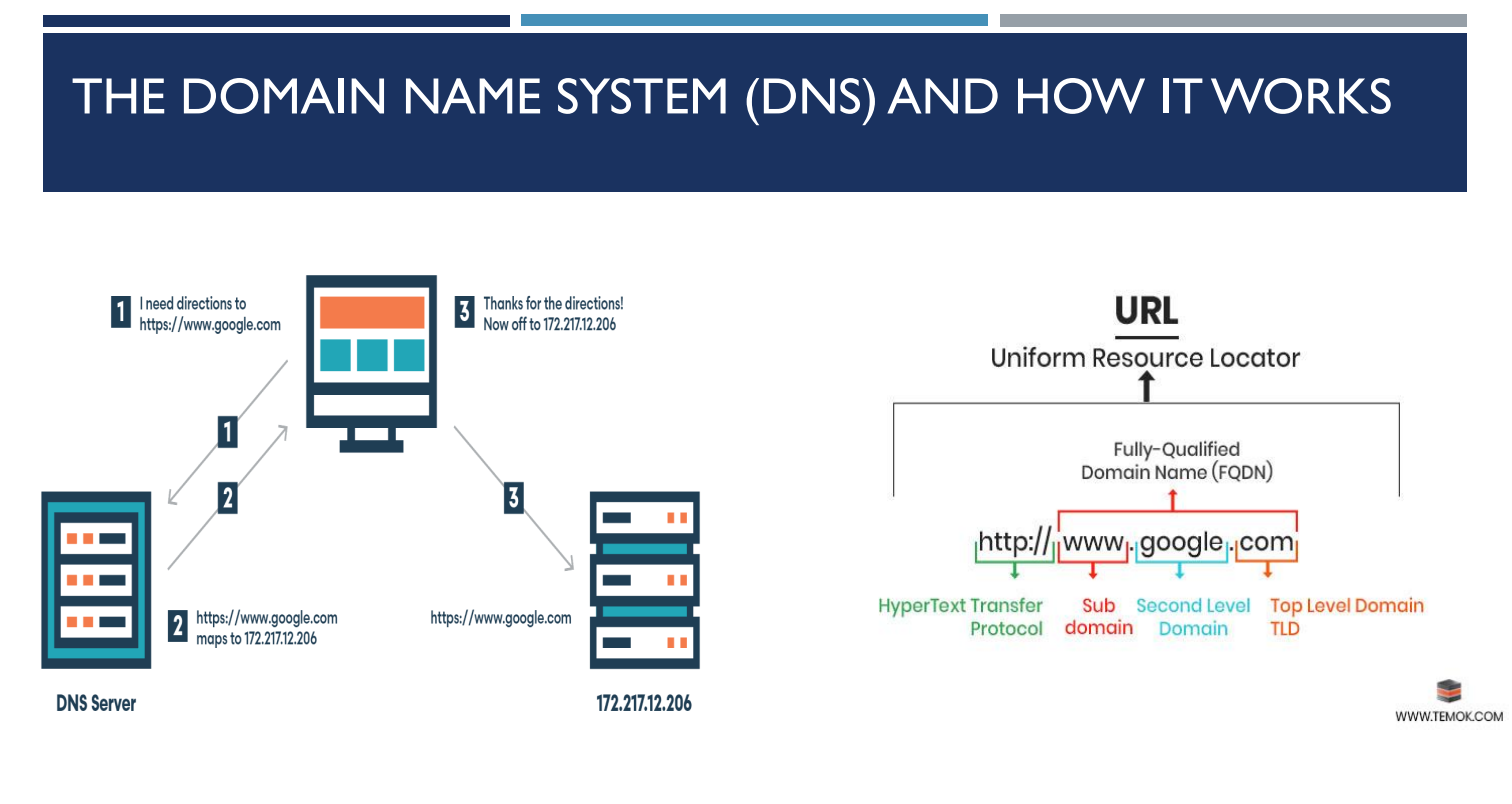
A presentation prepared for the recent Fifteenth Session of the World Intellectual Property Organization's Advisory Committee on Enforcement begins with a brief explainer of the Domain Name System (DNS) and how it works. The fundamental importance of DNS to the internet is glaringly obvious.

So that humans don't have to remember thousands of IP addresses to access their favorite websites, the DNS system holds all of those numbers in a database and matches them to more easily remembered domain names. When domain names are entered into a browser (Google.com, for example), DNS converts the domain into an IP address and the page appears. If done properly, it's completely invisible.
wipo - domain explainer

At the time of writing, a couple of billion websites rely on the ability of the DNS system to carry out these conversions. The problem for rightsholders is that some of those sites facilitate access to their copyrighted works, and with easy-to-remember names such as thepiratebay.org, they are too easy for people to find.

Following legal action, ISPs in dozens of countries are now required to prevent their customers from accessing sites like thepiratebay.org. Since ISPs carry their own copy of the DNS 'phone book', they look up thepiratebay.org, find the IP address allocated to it, and exchange it for a completely useless one.

Rightsholders like this arrangement. Critics say that internet infrastructure shouldn't tell lies to its users.

So Why Such Drastic Action? FMovies….and a Few Others

If The Pirate Bay's resistance to shutdown helped to fuel the early days of pirate site blocking, sites like FMovies may end up shouldering the blame for more extreme measures.

With close to 87 million visits per month via desktop alone, FMovies is not only massive but quite possibly the most comprehensive pirate VOD-style streaming site available today. It operates many domains in various jurisdictions under multiple brandings, and isn't confined to the mainstream movie and TV show 'niches' either.

Hollywood companies have forced ISPs in several countries to tamper with the site's local DNS entries after obtaining injunctions or voluntary cooperation. The site's traffic continues to grow because it's still online – DNS tampering cannot change that, not for FMovies or any other site

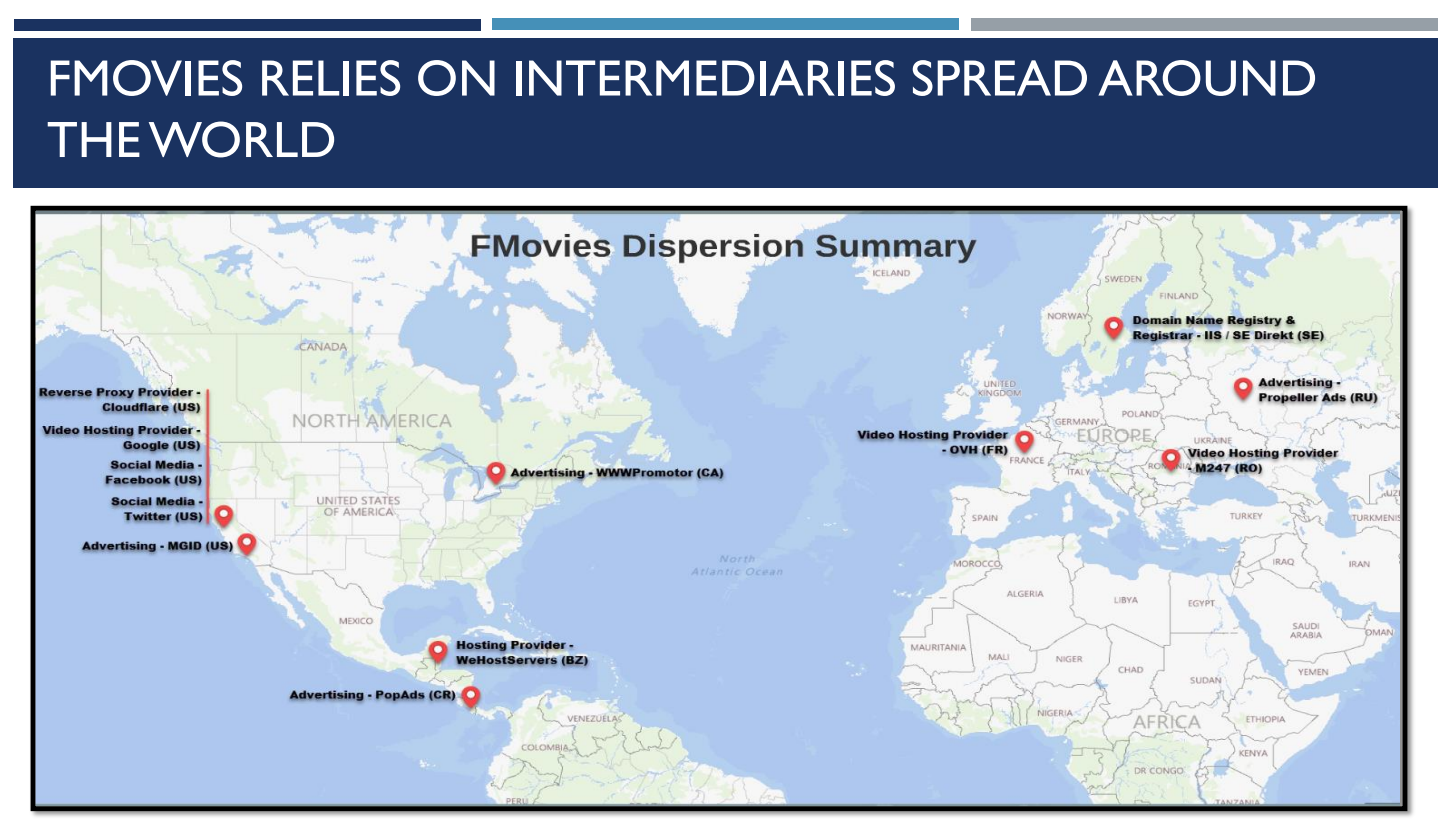
Perhaps the most surprising thing about the presentation is that it talks about options for action against DNS, yet reveals the countries where FMovies has infrastructure, names the companies allegedly supporting that infrastructure, and puts their locations on a map.
fmovies-wipo-infrastructure

So what action could be taken by DNS service providers to take FMovies offline, render it inaccessible, or even make it marginally less successful than it currently is? The presentation has some ideas but before we come to them, it might be worth looking at the slide again.

Why would meddling with the DNS system, which has zero ability to remove content, be preferred over actually removing content?

OVH and M247, two companies listed as serving FMovies, are very large hosting operations and couldn't hide even if they wanted to. The fact that they are in the EU renders them legally 'accessible' too, in the event that they are indeed playing host to one of the world's largest stashes of premium infringing content. They probably have no idea that's the case, of course, and being cash-rich their lawyers would be very happy to explain that, in court if necessary.

But the real problem here isn't who has the ability to fight back, it's that DNS interference has always been portrayed as a tool of last resort, something to be used when everything else fails. The presentation to the WIPO Enforcement Committee even states that DNS resolvers are completely incapable of removing infringing content.

"The legal frameworks and case law lack a clear picture at international and national levels. Case law mainly discusses liability as secondary infringers if DNS providers serve structurally copyright infringing websites. This usually requires intent, which could be established by a notice," it reads.

Sony Music certainly hopes that will be enough.

Quad9 DNS Resolver Dispute

In Germany, Swiss-based DNS resolver Quad9 is now in direct legal conflict with Sony Music after refusing to cooperate in the label's campaign to have a music piracy site blocked. Sony took the case to court, arguing that Quad9 has a duty of care to block the site – a site that doesn't carry infringing content itself but links to content hosted on another site (or sites), somewhere else entirely.

Perhaps with an eye on the type of intent mentioned above, Sony did indeed give Quad9 clear notice of the infringement. Unfortunately for Quad9, Germany sets the bar for involvement very low indeed, which makes it the perfect venue for this kind of lawsuit.

Under the legal concept of Störerhaftung, otherwise known as disturbance or disruptor liability, a disruptor is someone who is involved in any way with the distribution of illicit content. As involvement goes, Quad9's role is either extremely minimal or absolutely crucial, depending on perspective.

Sony currently appears to have the upper hand (1,2) and although it's not over yet(1), some liability protection has already been stripped away. According to a German regional court, since Quad9 only triggers IP address queries to DNS servers and transmits no information, it does not qualify for 'mere conduit' liability exemptions.

Cloudflare Ordered to Block Pirate Sites

If Quad9 loses, any order compelling it to block will be part of the package waved around in other jurisdictions to achieve the same goals: do providers want to cooperate now, or perhaps they prefer legal conscription? In the EU, this type of approach has a tendency to spread, where one ruling leads to another and then becomes the accepted norm as intermediaries concede defeat.

And momentum is building.

In July, an Italian court ordered Cloudflare to block three torrent sites on its public DNS resolver 1.1.1.1. Music industry group FIMI said that since the Cloudflare service helps people to access pirate sites, Cloudflare becomes part of the piracy problem. The court agreed and issued a preliminary injunction against Cloudflare.

While copyright holders have shown their intent in no uncertain terms, Cloudflare is drawing its own lines in the sand. While it has been compelled to block in both Italy and in Germany, Cloudflare recently said it will fight any 'global' blocking requests if they target its 1.1.1.1 DNS resolver.

Less Aggressive Options

If DNS entities get tired of the lawsuits, it's possible they could be tempted by so-called non-fault injunctions, the presentation suggests. Popular in the UK and India, the idea is that intermediaries are named as respondents in blocking applications but copyright holders have no intention to sue them.

Everyone involved acknowledges that the intermediaries are in a good position to help out and that everyone's rights should be respected under the principle of proportionality. This balances copyright holders' rights, the intermediaries' rights, and the rights of internet users to access information. The important thing is that there is no conflict and as long as applicants follow procedure, blocking tends to get the court's seal of approval.

Another favored option doesn't involve the courts at all because direct agreements between copyright holders and intermediaries do all of the heavy lifting. By designating groups such as the MPA as 'Trusted Notifiers', DNS entities could follow the lead of two domain registries and decide what should be blocked in private.

"Proactive measures by DNS providers to discourage online infringement and other illegal activity should be adopted, such as ensuring accuracy of registrant/WHOIS data. Voluntary reactive measures, such as trusted notifier arrangements, should be encouraged," the presentation concludes (pdf).

WIPO says that the views in the presentation on DNS providers and resolvers are those of the authors and are not necessarily shared by WIPO members. The authors are leading Germany copyright attorney Jan Bernd Nordemann and Dean S. Marks, former Deputy General Counsel and Chief of Global Content Protection at the MPA.

Image Credit: Jimmy Nilsson Masth (Unsplash License)

From: TF, for the latest news on copyright battles, piracy and more.


Powered by Mad Mimi®A GoDaddy® company

Saturday, October 1, 2022

Edit your subscription to TorrentFreak

Hi there,

To continue editing your subscription to TorrentFreak click here. You can also click here to unsubscribe.

If you're not trying to edit your subscription, no action is needed and you can safely ignore this email.

Thank you!

TorrentFreak's Latest News


Court Denies MindGeek's Request for a Sweeping Anti-Piracy Injunction
Ernesto Van der Sar, 30 Sep 10:12 PM

denied requestMindgeek is without doubt one of the largest and most powerful adult entertainment conglomerates in existence today.

The company effectively transformed the porn industry in less than a decade, luring people in with a promise of 'free' content. Mindgeek owns Pornhub, one of the most visited websites on the Internet, and is also the driving force behind YouPorn, RedTube, Tube8, Xtube, and dozens of other sites.

Several of these tube sites became big by offering access to a wide variety of content, including pirated videos that were posted by their users without permission. That doesn't mean that MindGeek is turning a blind eye to pirates. On the contrary.

MindGeek's current empire includes companies that create video content and own the rights. MG Premium, for example, has many thousands of copyrighted adult videos in its repertoire under popular brands such as Brazzers, Digital Playground, MOFOS, and Reality Kings. These videos are often pirated and shared through external sites, presenting a problem for the company.

MindGeek Sues Daftsex and Artporn

To address this issue, MindGeek's daughter company regularly goes to court. In a recent case, filed at the federal court in the District of Washington, Vasily Kharchenko, the alleged operator of Daftsex.com and Artporn.com, stands accused of mass copyright infringement.

These sites have been a thorn in MindGeek's side for years but targeting their domains with hundreds of thousands of DMCA takedown notices didn't produce the desired result. So, in 2020, MindGeek obtained a DMCA subpoena against Cloudflare to unmask their operator. This quest eventually led to Kharchenko.

MG Premium alleges that the operator personally uploaded 2,143 of its copyrighted works to the sites. Through the court, the company hopes to stop these infringements. In addition, the company demands compensation for the damages suffered.

Thus far, the lawsuit has been a one-sided battle, as Kharchenko didn't respond to the allegations at all. This prompted MG Premium to request a default judgment, asking for $15,000 in damages per infringement, for a total of $32,145,000.

Injuction Targets Verisign, Cloudflare, Namecheap and others

In addition, MG Premium also moved for a broad injunction that would require various third-party online services to cut their ties with the infringing sites and their alleged operator. The adult company believes that would help to shut down the piracy operation.

In addition to DaftSex and Artporn, the proposed injunction also includes Biqle.com and Daxab.com. The latter is a CDN for streaming videos, which is used by DaftSex and others. All these sites are allegedly run by Kharchenko.

Verisign, the registry responsible for .com, .net, .cc, and .tv domain names, is one of the third-party services mentioned in the proposed injunction. MindGeek wants Verisign to disable the Daftsex.com, Artsporn.com, Daxab.com, and Biqle.com domains and transfer them to the porn conglomerate.

In addition, other domain name companies, hosting, and CDN providers should be compelled to cut their ties with the sites in question. Those companies include Cloudflare, FDC Servers, Namecheap.com, NameSilo and PrivacyGuardian.org.

MG Premium's Proposed Order

proposed

An order of this magnitude would be very effective indeed, but the court had its reservations. Despite the fact that the accused failed to appear in court, United States District Judge Benjamin Settle denied the injunction.

Injuction Denied, For Now

According to the Judge, MG Premium should provide more details about the contacts between the defendant and the third-party services, in order to justify such a "sweeping" order.

"The Court is not prepared to issue a sweeping injunction against numerous nonparties based only on the conclusory, unsupported allegation that Vasily Kharchenko is in privity with them, or on the implausible claim that Kharchenko controls these entities," Judge Settle writes.

order denied

This means that MG Premium must go back to the drawing board and submit a new motion for a default judgment, supported by additional evidence and analysis.

If the company eventually gets its way this could spell trouble for other pirate sites as well. In any case, it will be interesting to see how the case develops and what the potential aftermath might be.

From: TF, for the latest news on copyright battles, piracy and more.

 
 
Powered by Mad Mimi®A GoDaddy® company