Tuesday, September 29, 2020

TorrentFreak's Latest News


Accused Movie Pirate Couple End Up in Court After Profane Tirade
Ernesto Van der Sar, 29 Sep 10:01 PM

cautionPiracy warnings come in all shapes and sizes. While some notices have no teeth, others should be handled with extreme caution.

Typically, alarm bells should go off when a letter is sent by a lawyer who knows who you are.

One such warning was sent to Mrs. Parks in early June, both by first class mail and e-mail. The Arizona woman is one of the people whose personal details were shared by the torrent site YTS, an issue we addressed in detail earlier.

Exposed by YTS Database Info

This YTS database ended up in the hands of anti-piracy attorney Kerry Culpepper, who's actively exploiting it. The lawyer represents several movie companies and has used the information in the database to request out of court settlements from pirates.

Mrs. Parks, who allegedly downloaded the film "Lost Child," was given the chance to resolve her case for $1,000 in four separate payments. If the first three payments arrived on time, the final $250 would be waived.

This same tactic is being used on dozens if not hundreds of alleged YTS users. It's not clear how many people settle, but Mrs. Parks and her husband Mr. Dabney initially seemed willing to take the deal, which was confirmed over the phone and via email on June 8.

Agreement to Settle for $1,000

After this initial agreement, communications stopped for a while. Parks and Dabney never sent back the signed settlement agreement and a reminder on August 31 remained unanswered.

This course of events was written up in a complaint filed at a federal court in Arizona yesterday. The plan was to resolve the matter outside of court, even after the same IP-address shared another movie last week.

"On or about September 21, 2020, after still having received no communication from Defendants, Plaintiffs' counsel determined that the same IP address Defendants used to download the torrent file for Lost Child (47.216.212.227) was used to download and share copies of the motion picture Saving Christmas," Culpepper informs the court.

The complaint lists both Mrs. Parks and Mr. Dabney as the defendants. They are accused of using one and the same YTS account and allegedly downloaded the film "Lost Child" last year and "Saving Christmas" a few days ago, after which the attorney sent another settlement request.

"On September 21, 2020, Plaintiffs' counsel sent Defendant Dabney a demand by email for the full $1000 of the settlement agreement and an additional $750 as damages for infringing the motion picture Saving Christmas," the complaint reads.

Husband Responds With Tirade

After weeks of silence, Mr. Dabney responded to that request. He was not open to any settlements, however, and accused the lawyer of being "a fraud and a scam," threatening to take action against the lawyer and his "fake law firm."

The movie companies' attorney responded by confirming that he would indeed file a lawsuit, reminding the alleged pirate that he wouldn't get far in court with such scandalous language. That didn't change the man's tone, however, on the contrary.

"Look here. You will NOT get a dime out out [sic] me. You think that language was bad you ain't seen sh*t fa**ot. That's not a threat that's a f*ckin promise. Put that in your records f*ckin bitch ni**a. Dude with a girls [sic] name. Get the f*ck out here and leave me family alone," he replied.

In a follow-up email, Mr. Dabney further urged the attorney to "…stop looking at [his] IP address…" while accusing him of "…watching [his] 3 year old through the camera…"

Case Goes to Court

Instead of backing off, the attorney quoted these emails in the complaint he filed at the US District Court of Arizona. Representing the owners of the films "Lost Child" and "Saving Christmas," he accuses the two defendants of both direct and contributory copyright infringement.

In addition, the complaint also includes a "breach of contract" allegation against Mrs. Parks, who allegedly failed to honor the settlement agreement that was agreed on earlier.

In court, the husband and wife now face damages claims that may end up being substantially higher than the original settlement. In addition to the damages claim, the complaint also requests compensation for legal costs and attorneys' fees.

A copy of the complaint, filed on behalf of Santa Files Productions LLC, and Laundry Films Inc is available here (pdf)

From: TF, for the latest news on copyright battles, piracy and more.

Plex Sues Streaming Service That Will Run Blockbuster Movies Before Theaters
Andy Maxwell, 29 Sep 11:51 AM

PlexSoon after the latest blockbuster movies hit cinemas, pirated copies are available for download from the Internet.

It's a problem that studios have been struggling to mitigate for decades but the practice of granting an exclusive theatrical window leaves a convenient gap for millions of pirates to exploit.

Day-and-Date Movies Delivered to Living Rooms

In an effort to service the market by offering more choice, several companies have publicized plans to bring first-run movies to the small screen, notably Napster co-founder Sean Parker and his company Screening Room. Over in India, local media company Zee Entertainment Enterprises has a similar project of its own almost ready to launch but is now facing legal opposition from the US.

Set to go live on October 2, 2020, premium VOD service Zee Plex is primed to not only provide a legal alternative to day-and-date piracy but also offer a service to millions of customers who are currently unable to visit cinemas due to coronavirus restrictions.

"We are very excited to bring this new offering to all the movie buffs across India and around the globe," Zee Studios CEO Shariq Patel announced earlier this month.

"While we all love to catch the latest movies at the nearest theatres, we sensed the need for a solution like Zee Plex, which gives the consumers flexibility and convenience, to catch their favorite films in the comfort of their homes, along with friends and family. We have received great interest from producers and are looking forward to release a strong slate of blockbusters across languages."

The big launch day will feature the new blockbuster movie Ka Pae Ranasingam featuring local superstar actor Vijay Sethupathi but not everyone is pleased by the move.

Plex, Inc. Says Zee Plex is Trading on its Good Name

With roots as a freeware project to port XBMC (now known as Kodi) to Mac OS X in 2007, OSXBMC quickly took a different direction to XBMC and renamed itself Plex. In 2009, Plex, Inc. was founded to carry the Plex project forward commercially and over the next 11 years established itself as one of the most recognizable brands in the media player space.

According to Plex, Inc., Zee Plex operator Zee Entertainment Enterprises is illegally trading off that hard-earned goodwill.

"Plex, the popular global streaming media platform for all your favorite media, today announced it has taken legal action against Zee Entertainment Enterprises Limited for trademark infringement," Plex, Inc. announced last evening.

"In September 2020, Zee announced it was launching a competing video service, titled Zee Plex, in an obvious attempt to trade off of the Plex brand and global goodwill. Available to consumers globally, Plex is taking measures to defend its intellectual property, and specifically, in this case, to protect its trademark and brand."

Plex is Not Just a Media Player – It's a Streaming Service Too

Plex is often associated with piracy due to some users utilizing the software to organize pirated media to create their own personal Netflix variants. As a result, it has been slammed as a "dangerous digital player" by content industry lobbyists for not doing enough to police users' behavior.

However, to dismiss Plex as "just another media player" is only telling half the story.

Last year the company revealed it had been forging deals to offer large libraries of licensed movies to its users and it now looks set to continue moving forward as a legitimate software and content distributor. This brings it face-to-face with various entities looking to trade on the Plex branding.

Trademark Breaches Are Common

Speaking with TorrentFreak just a few months ago, Plex told us that it was in a game of "whack-a-mole" trying to fight back against people using the Plex trademark for nefarious purposes. These breaches take many forms but at least one company had set up a VPN service claiming it was run by Plex, Inc. That software has now disappeared from Google Play but problems clearly still exist.

Plex, Inc. holds live trademarks covering various aspects of its business including 'Plex' ("Downloadable computer software in the field of digital media management for use in playing, organizing, indexing, searching, and transcoding digital video, audio and images".

Others that are "published for opposition" include Plex as "Downloadable computer software for use in streaming via the internet of ad-supported video on demand, subscription video on demand, transaction video on demand, music and podcasts and transmission of ad-supported video on demand, subscription video on demand, transaction video on demand, music and podcasts."

Plex, Inc. says its lawsuit alleging trademark infringement has been filed with the High Court of India and papers have been served on Zee Entertainment Enterprises via email. The matter should come up for hearing the coming days, Plex concludes.

From: TF, for the latest news on copyright battles, piracy and more.


Powered by Mad Mimi®A GoDaddy® company

Monday, September 28, 2020

TorrentFreak's Latest News


Russia Joins WIPO Project to Block Pirate Revenue But There's Still No Transparency
Andy Maxwell, 28 Sep 09:12 PM

Websites of all kinds generally need a steady stream of revenue to keep them online. Advertisers, sponsors and affiliate schemes all play a part and the position is generally no different for pirate sites.

That being said, by their very nature pirate sites have a more limited number of options when it comes to advertisers.

Years ago, many would use platforms such as Google's Adsense or similar mechanisms operated by various reputable third-party agencies but when advertising for mainstream brands began appearing alongside pirated content, copyright holders were quick to point out that household names should not be funding illegal activity.

This resulted in pressure on agencies around the world to stop doing indirect business with pirate platforms, with various coalitions creating their own pirate site 'blacklists' so that known pirate players could be screened out as potential advertising partners.

WIPO's 'Building Respect for Intellectual Property' Database

In 2017, the United Nation's World Intellectual Property Organisation (WIPO) threw its proposals into the mix with its BRIP (Building Respect for Intellectual Property) database. The plan, which came to fruition in 2019, would see "Authorized Contributors" and "Authorized Users" from WIPO Member States and the advertising sectors building a list of websites that are known to infringe copyright, so they could be avoided.

Early contributors included Italian telecom regulator AGCOM and KCOPA, the Korea Copyright Protection Agency. Earlier this year it was reported that Brazil was also cooperating in the project but information on precisely who else is involved is currently scarce, barring the latest new entrant.

Russia Joins the Renamed WIPO ALERT Database

According to Russian telecoms regulator Roscomnadzor, Russia has also decided to throw its weight behind the scheme following the signing of a Memorandum of Understanding earlier this month after a year-and-a-half of negotiations with WIPO.

"Roscomnadzor and the World Intellectual Property Organization (WIPO) have signed a Memorandum on the provision of information to the WIPO ALERT database," the announcement reads, referring to the new name for BRIP.

"The WIPO ALERT database is a mechanism that allows WIPO Member States and their institutions to share lists of infringing sites in order to discourage advertisers from placing advertisements on such sites.

"Roscomnadzor will provide for placement in the WIPO ALERT database information about sites on the Internet, on which information containing objects of copyright and (or) related rights have been repeatedly and illegally posted."

Who is Participating and What Are Their Criteria?

The above announcement by Russia indicates that the country's participation in WIPO ALERT is based on its established guidelines for local site-blocking. Sites that are reported multiple times due to the placement of copyrighted content on their platforms appear to be prime candidates for inclusion in the WIPO ALERT database. This is in line with the published aim of the project.

"WIPO ALERT is a secure, online platform to which authorized bodies in WIPO member states can upload details of websites or apps which have been determined to infringe copyright according to national rules," it reads.

What we can conclude from "national rules" is that sites can be added for ad-blocking when a local law is breached but, thus far, and based on information currently made public, participants other than Russia aren't so clear on their parameters.

In respect of AGCOM, for example, the regulator merely states that the memorandum it signed allows it to contribute to a list of websites "compiled at national level that violate authors' rights." (pdf)

The System Still Lacks Transparency

Visitors to the WIPO ALERT portal hoping to learn more are given very little information to go on.

"Advertisers, advertising agencies and their technical service providers can apply to become authorized users of WIPO ALERT in order to access aggregated lists of infringing websites from around the world," the site reads.

"They can use this information in their automated advertising systems to avoid placing advertisements on such sites. In this way, they can avoid subsidizing copyright infringement and protect their brands from the negative reputational effect of association with illegal activities."

That sounds effective in theory but who is checking for errors and overreach, and who is responsible for ensuring that everything is kept up to date? Not the WIPO, that much is certain.

"WIPO does not assess whether any website is infringing and does not take any responsibility for the contents of the national lists hosted on the WIPO ALERT platform," the organization writes.

So if a site gets added to a list erroneously or even maliciously (we only need to turn to Google's Transparency Report on DMCA notices to see thousands of instances of both), how can that be rectified? The WIPO offers the following advice:

"Warning – any concerns as to the inclusion or omission of a website from a list must be pursued with the national agency concerned," it states.

The problems here are obvious. There is no public list of "national agencies" that are able to contribute to the project and even when those are known, they won't share their lists with the public. This means that it's not only impossible for parties to examine the lists for errors but owners of domains that are wrongly included will not even know they are being blacklisted. All they will see is a reduced ability to generate revenue from advertising.

Avoiding Pirate Sites is Understandable But Business Works Both Ways

That many if not most advertisers would prefer for their brands not to appear alongside pages of pirated content is completely understandable. Advertising is all about perception and in the same way that big companies wouldn't like their carefully cultivated imagery appearing alongside crazy conspiracy theorists on YouTube, association with pirated copies of Tenet or Mulan would probably be a no-no too.

However, some companies operating in the anti-piracy space, hired by copyright holders that are comfortable with their standards, are just as comfortable blacklisting news articles that simply report on leaks of Tenet as they labeling the BBC a piracy portal. Or, as we revealed this weekend, labeling a French ISP and phone manufacturer Huawei as running two of the world's Top 50 piracy portals.

Not placing advertising on these sites, for example, could mean lucrative advertising deals lost, with brands, agencies, and potential platforms all coming out poorer.

Unfortunately, however, those who run national advertising blacklists such as the UK's PIPCU (Infringing Website List) and AGCOM, for example, have absolutely no intention of making these available to the public. Why not is a complete mystery since all of the major pirate sites are public knowledge due to Google's Transparency Report and the invaluable Lumen Database.

That leaves the possibilities that third-party scrutiny is undesirable, either because contributors prefer not to justify their decisions and/or mistakes could prove embarrassing and undermine credibility. Nevertheless, it would make for more accurate blacklists, which must be the goal overall, surely?

From: TF, for the latest news on copyright battles, piracy and more.

Greek Pirate Site Blockade Expands With Hundreds of Pirate Bay, YTS, and 1337x Domains
Ernesto Van der Sar, 28 Sep 10:07 AM

blockedISP blocking has become a prime measure for the entertainment industry to target pirate sites on the Internet.

The practice has been around for over a decade and has gradually expanded to dozens of countries around the world.

This is also the case in Greece, where the first blockades were issued in 2018. The Greek blocks are overseen by the IPPC, a special commission at the Greek Ministry of Culture and Sports that acts following complaints from rightsholders.

The Greek system is different from that of many other countries because it doesn't involve a court. It's an administrative procedure which allows copyright holders to swiftly request pirate site blockades, without the need for lengthy and costly legal proceedings.

The most recent blocking request was filed by the Society for the Protection of Audiovisual Works (EPOE), a local anti-piracy group that represents the interests of major Greek copyright holders. The company previously obtained a blocking order against The Pirate Bay, 1337x, and YTS, but requested to expand it.

Blocking Pirate Proxies and Alternaitives

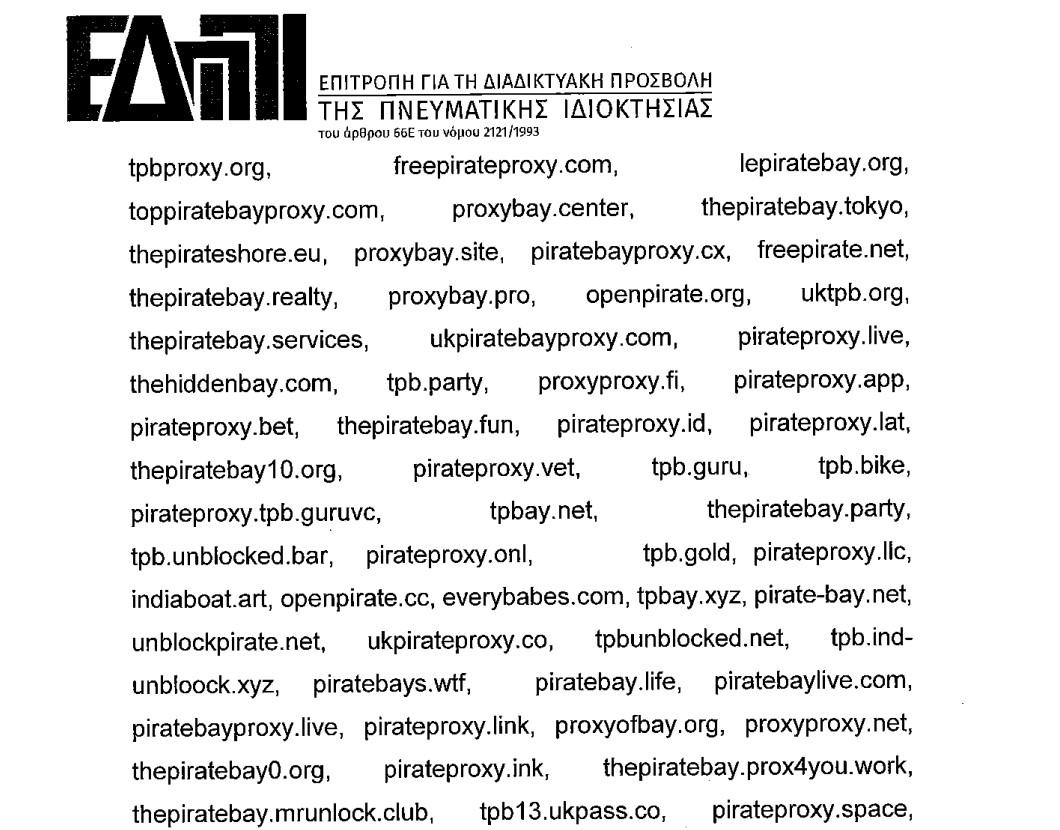
While the original order does its job, Greek pirates swiftly moved to alternative proxy sites. The anti-piracy group, therefore, asked more than 200 of these Pirate Bay, 1337x, and YTS proxies to be blocked as well.

greek pirate block

Following careful deliberation, the IPPC decided to expand the Greek pirate site blockade. The Government organization concluded that, for the vast majority of the domains, the database, structure, graphics, and user-interface were substantially similar to the sites that were blocked originally.

In addition to The Pirate Bay, 1337x, and YTS, several subtitle domains, and local pirate sites including GamaTV were targeted as well.

One Request Denied

Before issuing a new order, the owners of the domains were given the option to object to the request. This includes the administrator of subtitle site subs4series.com, who claimed that his site was wrongfully targeted.

The blocking application claimed that subs4series.com was similar to the previously blocked subs4free.info, which the site's administrator denied. The Government organization agreed and rejected the requested blockade.

"After the relevant research, it appears that the site with the domain name subs4series.com does not redirect to the site with the domain name subs4free.info. Therefore, according to the relevant allegation of the applicant, there is no violation, as it concerns the no. 3/2018 decision of the Commission for the Internet Infringement of Intellectual Property," IPPC writes.

The blocking order is valid for three years and applies to all Greek Internet providers. They're given 48 hours to add the 264 new domains to their blocklists, including more than 120 Pirate Bay proxies. If the companies fail to comply they risk a fine of €850 per day.

—-

A copy of the most recent blocking order, issued by IPPC, is available here (pdf) This also includes a list of all targeted domains

From: TF, for the latest news on copyright battles, piracy and more.

Top 10 Most Torrented Movies of The Week – 09/28/20
Ernesto Van der Sar, 28 Sep 09:14 AM

enola holmesThe data for our weekly download chart is estimated by TorrentFreak, and is for informational and educational reference only.

These torrent download statistics are meant to provide further insight into the piracy trends. All data are gathered from public resources.

This week we have one new entry in the list. Netflix's depiction of Enola Holmes, starring Millie Bobby Brown, is the most downloaded film this week. The movie was released on September 23 and surfaced on pirate sites soon after.

The most torrented movies for the week ending on September 28 are:

Movie Rank Rank last week Movie name IMDb Rating / Trailer
Most downloaded movies via torrent sites
1 (…) Enola Holmes 6.7 / trailer
2 (1) Mulan 5.7 / trailer
3 (3) Antebellum 5.5 / trailer
4 (4) Ava 5.4 / trailer
5 (2) The Devil All The Time 7.2 / trailer
6 (7) Greyhound 7.1 / trailer
7 (5) Bill & Ted Face the Music 6.5 / trailer
8 (6) Tenet 7.9 / trailer
9 (9) Project Power 6.1 / trailer
10 (8) Peninsula 5.6 / trailer

Note: We also publish an updating archive of all the list of weekly most torrented movies lists.

From: TF, for the latest news on copyright battles, piracy and more.


Powered by Mad Mimi®A GoDaddy® company