Sunday, May 3, 2020

TorrentFreak's Latest News


Charter Must Share Personal Info of Pirating Subscribers With Record Labels
Ernesto, 03 May 11:29 PM

Every day, ISPs send thousands of copyright infringement notices to subscribers, informing them that their connections have been used to download pirated content.

These warnings have long been without consequences. However, copyright holders in the US are working hard to change that.

The major record labels filed several lawsuits against ISPs for failing to terminate repeat infringers. These are serious claims, as became apparent from a billion-dollar damages judgment against Cox not too long ago.

Charter Communications is currently caught up in a similar lawsuit. The company, which has millions of subscribers, endured a setback last month when its motion to dismiss the vicarious copyright infringement claims was dismissed.

This week there is more bad news. As part of the discovery process, the music companies asked Charter to hand over the personal information of roughly 11,000 subscribers who received infringement notices. The ISP refused to do so, but the music companies insisted.

To break this stalemate, the court asked special master Regina Rodriguez to decide over the issue. This week she released her order, which is somewhat of a compromise.

Charter argued that handing over the personal details would cause piracy issues. In addition, it would be a burdensome process as the California Consumer Privacy Act requires the ISP to notify all these customers to allow them to respond.

In her order (pdf), Rodriguez agrees that this would indeed be burdensome, also for the court.

"While the information may be relevant, the notification of 11,000+ customers, and the potential legal challenges flowing therefrom, would be burdensome to the parties as well as to the courts," she writes.

As a solution, she suggested limiting the hand over of personal information to a small subset of alleged pirates. Both parties were asked to agree on how large this sample would be, which resulted in the following compromise.

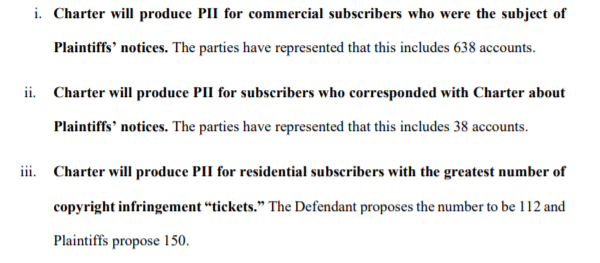
Charter is required to share the personal details of all commercial subscribers who received notices, 638 in total. In addition, the ISP must also share information on the 112 subscribers who received the most notices, as well as the 38 subscribers who reached out to Charter about the notices.

The music companies also requested DHCP logs from Charter to link copyright infringement notices to particular subscribers. The ISP countered that the logs would not be sufficient to do this, but admitted that querying its internal systems would make it possible. This request was also granted by the court.

"Defendant is ordered to produce information sufficient for Plaintiffs to match the IP addresses contained in infringement notices served on Charter with particular subscribers," Rodriguez ordered.

The full order lists several other requirements and also includes some good news for the ISP. For example, it asked for a full harddrive with evidence from the anti-piracy company MarkMonitor, which the music companies used to track the infringing activity.

MarkMonitor shared this information, but only with the music companies. These are now required to share everything, including all metadata, with the ISP.

"The Plaintiffs inserted themselves into the dispute when they accepted the production from MarkMonitor, and they cannot now attempt to sidestep their assumed obligation to produce accurate information," the order reads.

How the record labels plan to use the subscriber information to assist their case against Charter is not entirely clear. It is possible, however, that they will reach out to some alleged infringers to gather further evidence against the ISP.

From: TF, for the latest news on copyright battles, torrent sites and more. We also help you to find the best anonymous VPN.

Denmark Blocked 141 Pirate Sites in 2019 But Pirates Are Bypassing The System
Andy, 03 May 01:19 PM

Site-blocking to disrupt copyright infringement now takes place in dozens of countries around the world, with its supposed benefits currently being aggressively promoted to lawmakers in the United States.

Having been pioneered in the country more than a decade ago, site-blocking is old news in Denmark but is still one of the preferred methods to reduce access to 'pirate' sites. Indeed, according to a report published by leading anti-piracy group Rights Alliance, during 2019 alone it managed to have 141 sites blocked by the majority of ISPs in the country.

In tandem with other anti-piracy initiatives, this appears to have had a drastic effect on local visits to pirate sites. According to the group, in 2018 Danes visited pirate sites 239 million times yet in 2019, that figure was down to 146 million, an impressive 40 percent drop.

When copyright groups measure the effectiveness of blockades it's worth noting that they often measure traffic levels to the domains that have been blocked. When nearly all ISPs in a country participate in blocking, which is the case in Denmark, there will quite clearly be a reduction in visits to those specific domains. But that doesn't necessarily mean that people aren't still using them or, indeed, alternative platforms.

Indeed, Rights Alliance (RA) notes that despite the reductions in traffic to 'pirate' domains, a recent study revealed that the number of pirates in Denmark hasn't reduced at all.

"According to Mediavision's annual user behavior survey in the Nordic countries, the proportion of Danish 15 to 74-year-olds who download or stream movies and TV series is stable at 10 percent, which it has been since 2016. This corresponds to approximately 450,000 Danes using illegal sites annually," RA notes.

"An explanation of the decreased number of visits, but the stable number of users, we partly attribute to the blocking effect, but other causal explanations are also available. Namely, the Mediavision study points out the Danes' use of so-called VPN connections and the use of alternative DNS providers that allow the blocking to be bypassed."

When questioned for the survey, 17% of Danish Internet users said they use a VPN. However, when the subset of self-confessed pirates were asked the same question, 44% admitted to using a VPN to access pirated movies. According to RA, this indicates that VPNs are widely used by pirates so the 40% drop in traffic to pirate sites could be overstated.

"The study thus shows that VPN connections are very widespread among those who stream and download illegally so their use of illegal websites is not included in the aforementioned 146 million visits. The figure may actually be higher," RA adds.

The problem is replicated when looking at how Danish ISPs block their subscribers' access to pirate sites. Court orders allow them to block by interfering with DNS but users are apparently well aware that if they switch to a DNS provider that isn't run by their ISP but by OpenDNS or Google, for example, blocking can be bypassed.

"[S]o-called alternative DNS providers are also being used by more Danes who illegally download or stream movies and TV series than the general population," RA reports.

"Ten percent of Danes who do not stream or download illegally have heard of alternative DNS providers, and out of them, 35 percent use them. If you look at the Danes who stream and download illegally, 23 percent have knowledge of DNS providers and as many as 97 percent use them."

The end result is that despite widespread blocking and a headline drop in traffic to pirate sites, the number of pirate consumers remains stable, apparently undeterred by the measures. So the big question remains: what can be done to further reduce piracy levels?

On the blocking front, RA is pushing the concept of so-called 'trusted notifiers', i.e organizations or groups that have access to a streamlined blocking mechanism, preferably handled by a single court dealing with IP crime. Also on the table is potential action by SØIK, the State Prosecutor for Serious Economic and International Crime, which could require ISPs to block sites without a court process.

In respect of enforcement, Rights Alliance says that it has also identified a number of individuals who have "made extensive use of illegal services." Data about them and their activities has been passed to the IP Task Force at SØIK but what will become of those referrals remains unclear.

The full report can be found here (Danish, pdf)

From: TF, for the latest news on copyright battles, torrent sites and more. We also help you to find the best anonymous VPN.


Powered by Mad Mimi®A GoDaddy® company

Saturday, May 2, 2020

TorrentFreak's Latest News


YouTube Rippers and Record Labels Clash in US Appeals Court
Ernesto, 02 May 11:21 PM

In 2018, a group of prominent record labels filed a piracy lawsuit against two very popular YouTube rippers, FLVTO.biz and 2conv.com.

The labels, including Universal, Warner Bros, and Sony, hoped that the legal pressure would shut the sites down, but this plan backfired. At least in the short term.

The Russian operator of the sites, Tofig Kurbanov, fought back with a motion to dismiss. He argued that the Virginia federal court lacked personal jurisdiction as he operated the sites from abroad and didn't target or interact with US users.

The district court agreed with this assessment. In a verdict released early last year, Judge Claude M. Hilton dismissed the case. The Court carefully reviewed how the sites operated and found no evidence that they purposefully targeted either Virginia or the United States.

The record labels and the RIAA were disappointed with the outcome and swiftly announced an appeal. The landmark verdict also raised the interest of other groups, including the Motion Picture Association and EFF, which both filed amicus briefs, supporting the opposing sides.

After several months had passed, the US Court of Appeals for the Fourth Circuit held a remote oral hearing this week, giving both sides the opportunity to share their arguments.

First up was Ian Heath Gershengorn, attorney for the record labels, who described FLVTO.biz and 2conv.com as sites that help millions of people to infringe the copyrights of his clients.

"Defendants operate wildly popular websites that engage in and facilitate massive infringement of plaintiffs U.S. copyrights in the United States. The United States is defendant's third-biggest market, and each year defendants make handsome profits by sending hundreds of millions of infringing music files to their U.S. users," he said.

This is no different than copies of hundreds of millions of vinyl records or CDs, the attorney informed the judges. The record labels believe that the district court made a grave mistake by ruling that it doesn't have jurisdiction, one that provides "a roadmap" for pirate sites to "operate with impunity."

According to the music companies, the lower court's judgment should be overturned for various reasons. This includes the sheer volume of the infringements, the interactive characteristics of the sites, their commercial advertising agreements, and the sites' failure to block US visitors.

In addition, their attorney points out that the sites had a registered DMCA agent listed at the US Copyright Office, which shows that he subjected himself to US law.

"The only point and I guess the principle point of that DMCA agent is to invoke the protections of the DMCA, the Digital Millennium Copyright Act. And so they have literally invoked the protections of U.S. law. The district court concluded otherwise," Gershengorn said.

The attorney for FLVTO.biz and 2conv.com, Evan Fray-Witzer, has a completely different take on the case. He told the judges that the district court was right and that his client should not be dragged into a US lawsuit.

He describes Tofig Kurbanov as a Russian citizen from a small city in southern Russia who has never traveled to the United States and hasn't done any business there. Kurbanov simply made a site that allows users to download audio from YouTube, which the attorney equates to a modern-day version of a tape recorder.

"Mr. Kurbanov created two Web sites, which he has operated entirely and exclusively from Russia. These Web sites, your honor, are the modern-day equivalent of an old fashioned tape recorder," Fray-Witzer said.

Much of the discussion revolved around the interpretation of current personal jurisdiction precedents and how these apply to this case. That includes the advertisements that third parties placed on the site, the availability of the site in the US, and the absence of any geo-blocking restrictions.

The attorney stressed that Kurbanov simply made his websites available worldwide and did nothing to target the US specifically. He doesn't decide which ads are served where, and what users do with the sites is up to them.

On top of that, he pointed out that the site has many different uses. This includes the option to download free lectures for offline use.

"And that's really, I think, probably the best case argument here. Mr. Kurbanov has done nothing to target the United States. The websites are content-neutral," Fray-Witzer said.

While the sites have a DMCA agent the attorney argues that they are not bound by the DMCA, which the site's terms of service clearly state. In addition, he argues that registering a DMCA agent doesn't automatically mean that a site subjects itself to US jurisdiction.

At the and of the hearing the microphone went back to the music companies' attorney who, among other things, wasn't convinced by the other side's arguments. This includes the tape recorder analogy.

"If you had an old fashioned tape recorder and you recorded hundreds of millions of songs and then you sent those out to users across the world, including more than 100 million in the United States, yes, you would be subject to jurisdiction in the United States for that misuse and abuse of your tape recorder," he said.

The music companies hope that the appeal court will agree. If not, then the US may have little recourse to deal with foreign pirates sites going forward.

"Then this court has created the recipe for infringement that every pirate Web site will adapt and it will eviscerate the U.S. copyright laws. That is not the purpose of personal jurisdiction. And it's a perversion of due process," the music companies' attorney concluded.

From: TF, for the latest news on copyright battles, torrent sites and more. We also help you to find the best anonymous VPN.

Nites.tv Mystery Solved as MPA Takes Over Domain of 'Viral' Pirate Site
Andy, 02 May 11:54 AM

Any pirate movie or TV show site operating on the Internet today at any scale can eventually expect to find copyright holders breathing down their neck.

Aside from the thousands and in some cases millions of DMCA takedown notices filed with Google aimed at disappearing their platforms from search results, site operators can also find themselves targeted more personally. For the past couple of years that attention has increasingly come from ACE, the Alliance For Creativity and Entertainment.

Compromised of dozens of leading content companies, distributors and broadcasters and headed up by the Motion Picture Association, ACE is now the most potent anti-piracy coalition on the planet. With massive resources at its disposal, ACE has filed and won lawsuits against several streaming operations and in many cases, has had piracy-focused platforms capitulate following the mere threat of force.

In the weeks leading up to mid-April, streaming site Nites.tv suddenly started getting a lot of attention in the press. Quite why this happened seemingly out of nowhere remains unclear but several publications noted a social media campaign promoting the streaming platform. With a large library of movies and TV shows and a happy userbase, things appeared on the up but within days, Nites.tv was no more.

As previously reported by TF, the Nites.tv domain suddenly started redirecting to the ACE anti-piracy portal. However, the apparent 'seizure' bore none of the usual behind-the-scenes technical hallmarks usually associated with an ACE/MPA takeover.

But if nothing else, Nites.tv seemed spooked. Instead of the usual promotional messages on Twitter, the site's operators suddenly surprised their followers, changing their tone in a single tweet.

"We take copyright violations very seriously and will vigorously protect the rights of legal copyright owners. For that we decided to shut down our services. We are working on other ways to show you good content in a legal way," the platform announced.

The domain diversion to ACE and the tweet certainly suggested that trouble was afoot but at no point did Nites.tv reference the anti-piracy group, a position maintained today. However, this week it was all but confirmed that ACE had jumped in to shut Nites.tv down, when its domain was transferred to the Motion Picture Association.

In common with the majority of domains registered in the name of the MPA, the domain registrar is now MarkMonitor, the brand protection company that works with the MPA and other companies to protect them from piracy, fraud and cybersquatting. The details are an exact match for other domains taken over by the MPA/ACE and suggest that beyond a reasonable doubt, ACE threats were the reason for Nites.tv's sudden closure.

The only missing piece of the puzzle is that most 'pirate' domains seized by the MPA (or, more accurately, transferred) are quickly switched to nameservers operated by the Hollywood group. In Nites' case, that didn't happen until a day or two ago but with that now established, the seizure is complete.

From: TF, for the latest news on copyright battles, torrent sites and more. We also help you to find the best anonymous VPN.


Powered by Mad Mimi®A GoDaddy® company

Friday, May 1, 2020

TorrentFreak's Latest News


Watch Tower Sues Journalists For Millions in Copyright Infringement Damages
Andy, 01 May 06:52 PM

The Jehovah's Witness religious group is perhaps best known for knocking on doors to recruit new followers to the faith. When it comes to their promotional videos and documents, however, the organization takes a very different approach.

As reported recently, people who post their videos to YouTube, for example, can find themselves on the wrong end of a copyright lawsuit. On Thursday, that's what happened to journalists Ryan McKnight and Ethan Gregory Dodge, who together founded Truth & Transparency (TTF), a site with a mission to provide "religious accountability through impact journalism".

According to a lawsuit filed in a New York district court by the Watch Tower Bible and Tract Society, the supervising body and publisher for the Jehovah's Witness religious group, the pair committed massive copyright infringement for illegally distributing Watch Tower's "motion picture" works.

The complaint alleges that in mid-2018, Watch Tower discovered that 487 of its "copyrighted literary works" had been posted by the defendants on FaithLeaks.org, a site presented in a Wikileaks-style format. Late December 2018, Watch Tower demanded that the works be taken down, alleging breaches of copyright. The defendants reportedly refused to remove the content, claiming fair use under the Copyright Act.

Then, in May 2019, Watch Tower learned that "74 motion pictures" to which it holds the copyrights had been uploaded to RuTube.ru, a Russia-based YouTube-like platform. Watch Tower sent takedown notices to RuTube which resulted in the videos being removed. Shortly after, however, it's alleged that McKnight and Dodge re-uploaded the videos to FaithLeaks where they remain available today.

Watch Tower points to a May 2019 article published on TruthandTransparency.org in which the defendants "boasted not only about their past infringements and refusals to comply with Watch Tower's efforts to enforce its copyrights, but also about these new infringements, leaving no doubt as to Defendants' willfulness."

The article in question suggests that the videos, apparently recordings of conventions to which the public was invited, were indeed uploaded by the defendants, to elicit commentary and critique from observers. The article further notes that Watch Tower was approached for comment on the event but failed to respond. Albeit several months later, it has now.

In a complaint that details every video and alleged infringements one by one, there are repeated allegations that the defendants "unlawfully copied, reproduced, publicly displayed, publicly performed and distributed" Watch Tower's videos, in their entirety and without alteration. Dozens of pages of evidence later, the religious group reaches its conclusion.

"Defendants McKnight and Dodge personally participated in, and supervised and directed, the infringing acts described above. Indeed, they personally conceived of, and directed and approved all key aspects of, TTF's infringing activities. They were the moving force behind those infringing acts," it reads.

"The acts of Defendants described above were committed without the permission, license or consent of Watch Tower. Upon information and belief, the acts of Defendants described above were committed with knowledge or in reckless disregard of Watch Tower's exclusive rights in the Watch Tower videos.

"Plaintiff, accordingly, seeks injunctive relief and statutory damages for willful copyright infringement."

Given that damages for willful copyright infringement can reach $150,000 per infringed work, McKnight and Dodge are facing a potentially massive damages claim running to millions of dollars. Additionally, Watch Tower is demanding the removal of the videos and an injunction which prevents infringement of its copyrights moving forward.

TorrentFreak approached both McKnight and Dodge for comment on but at this time, the journalists declined.

The complaint, filed in a New York district court, can be found here (pdf)

Image credit: Pixabay

From: TF, for the latest news on copyright battles, torrent sites and more. We also help you to find the best anonymous VPN.

Pirated 'DVD Screeners' Will be History After Next Year's Oscars
Ernesto, 01 May 11:28 AM

The Oscars is the most watched awards show of the year. It's widely covered in the press and highly anticipated by movie fans.

In the weeks leading up to the awards ceremony, movie pirates also have something to be excited about: screener leaks.

Many Oscar screeners, which are sent to Academy members as part of the voting process, end up in the hands of pirates. When that happens, the leaked screeners are typically shared by millions of people.

The leaks are often tagged "DVDscr," referring to the DVD screener source format which is still in use. While streaming screeners have become more and more common, tens of thousands of physical screener copies are still sent out via mail.

This year, plenty of discs will be shipped too but, after the upcoming Oscars ceremony, that will be a thing of the past. The Academy of Motion Picture Arts and Sciences announced this week that physical screeners will no longer be allowed in 2021.

"[T]he 93rd Awards season will be the final year DVD screeners will be allowed to be distributed; these mailings will be discontinued starting in 2021 for the 94th Academy Awards," the Academy writes.

The Oscars follow the same path as the Emmys, which already made the switch this year. According to the Academy, the transition is part of its sustainability efforts. This also includes a ban on physical music CDs, hard copies of screenplays, paper invites, and other things that possibly hurt the environment.

Banning physical screeners will indeed be much more sustainable. Manufacturing tens of thousands of discs and shipping these all over the country takes up more resources than sharing a link to an online screener. As an added benefit, it also saves the studios a lot of money.

Piracy is not mentioned by the Academy but the transition does mean that the infamous 'DVDscr' tag will eventually be obsolete for Oscar screeners. That marks the end of an era.

Whether piracy was considered as a factor at all remains a guess. Some insiders believe that digital screeners are easier to protect and therefore more secure, but that is up for debate.

There may be fewer leak opportunities in the distribution process, but it's common knowledge that streaming platforms can be easily compromised. In fact, we have already seen several screeners being leaked from online sources. This was corroborated by pirate release group EVO last year.

"We had access to digital screeners and they are indeed easy to leak. The DRM on it is a joke. We had an account last year with three screeners on it and they were pretty much MP4 ready to encode," the EVO team informed us at the time.

Whether streaming or physical screeners are more secure ultimately depends on the type of protection measures that are implemented for each. The safest conclusion, for now, is that piracy will likely remain a problem no matter what the distribution platform is.

Two years from now, we'll likely know more. During the upcoming season, however, there will likely several 'DVDscr' leaks again.

From: TF, for the latest news on copyright battles, torrent sites and more. We also help you to find the best anonymous VPN.


Powered by Mad Mimi®A GoDaddy® company